From Bug Reporting to Quality Consulting
Why consulting is the next step after finding bugs
The fundamental transformation of paradigms in modern software engineering has fundamentally changed the role of testing experts. This development is moving away from purely executive operators towards strategic consultants who are deeply integrated into an organisation’s business and development processes. In an era that demands an extremely short time-to-market alongside uncompromising quality, traditional approaches are proving increasingly inadequate. The conventional model, which regarded testing as an isolated phase at the end of the development cycle, can no longer meet today’s business requirements. A simple bug report remains a necessary part of operational work, but as a standalone instrument it falls far short of preventing the immense costs caused by software defects.
Industry statistics impressively demonstrate the economic necessity of this shift. The cost of fixing a defect in the production phase can quickly be up to a hundred times higher than identifying the same flaw during the early requirements or design phase. This analysis examines the transition from merely finding bugs towards cross-functional quality engineering, or a full-lifecycle QA strategy, and explains why the advisory function represents the necessary evolutionary step after mastering technical testing skills.
Theoretical foundations of the transformation: distinguishing the quality disciplines
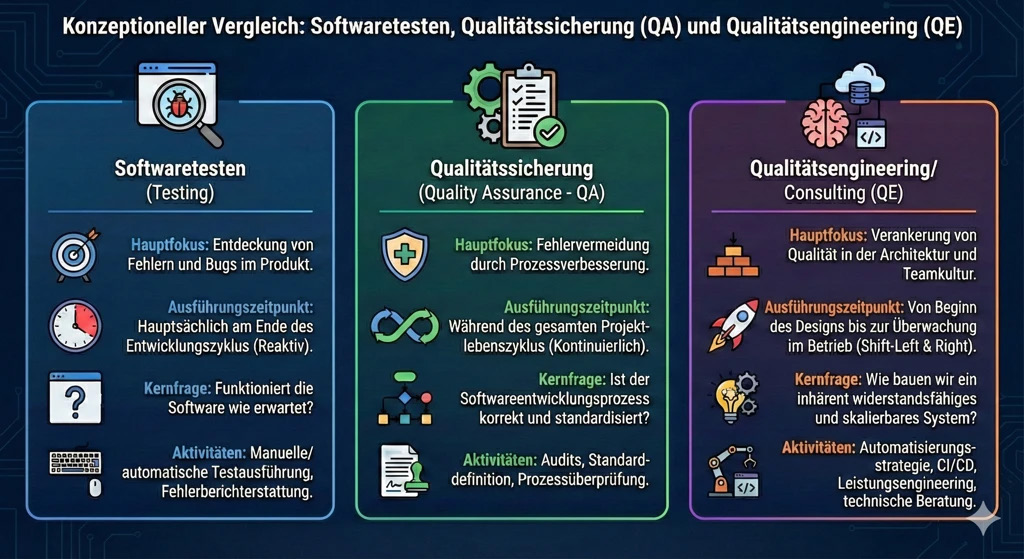
To grasp the depth of the quality-consulting concept, a precise terminological distinction between the often synonymously used terms software testing, quality assurance (QA) and quality engineering (QE) — i.e. quality consulting — is required. Software testing is traditionally a reactive activity focused on identifying deviations between the actual and target state of a finished product. Quality assurance (QA), by contrast, is process-oriented and proactively designed. Its goal is to ensure that the applied processes actually lead to a high-quality end product (“the journey is the destination”).
Quality consulting, or quality engineering (QE), goes beyond these definitions. Here, quality is anchored as an integral culture and shared responsibility throughout the entire organisational structure. The quality consultant does not act as a gatekeeper but as an enabler who designs systems so that they are inherently stable.
The following table illustrates the structural differences between the various maturity levels of quality assurance:
Economic dimensions and the management of hidden costs
The need to move towards consulting is inseparably linked to the economic steering of software projects. Quality costs are made up of prevention costs, appraisal costs, and internal and external failure costs. Test analysts in an advisory capacity help organisations avoid the accumulation of technical debt by implementing a consistent “shift-left” strategy.
A quality consultant creates value by establishing preventive methods that can demonstrably reduce total testing costs by up to 50 percent and significantly accelerate time-to-market. This strategic contribution exceeds the purely operational ability of a tester merely to find superficial bugs. Implementing continuous compliance and automated test-level concepts is a central success factor here.
A central instrument of the consultant is the risk-based testing approach. Here the expert advises stakeholders on which parts of the system have the highest probability of failure and the most serious business impact. This enables optimal prioritisation of limited testing resources.
Modern Testing Principles: the roadmap for quality consultants
In 2017, Alan Page and Brent Jensen defined the “Modern Testing Principles,” which underline the advisory character of the testing role in the age of DevOps and agility. These principles call for a departure from the role of the tester as a “safety net.” Instead, the entire team holds “shared responsibility” and “quality ownership.” The core principles include, among others:
- Business orientation: The goal is to improve the business, not to find bugs.
- Acceleration: Using lean thinking to eliminate process bottlenecks.
- Culture over control: Fostering a culture of quality instead of rigid control mechanisms.
- Data-driven decisions: Using feedback loops to validate product hypotheses.
This paradigm shift from “performing testing” to “enabling quality” forms the core of modern quality consulting. The role is evolving towards the generalist or “generalizing specialist,” whose strength lies in the breadth of their knowledge.
Transition to the role of quality coach in agile environments
In agile teams, the role of the tester is increasingly shifting towards the “quality coach.” A quality coach no longer necessarily writes all the test cases themselves, but coordinates the activities between development and testing. They act as a mentor who teaches the team how to build high-quality software.
Tasks of a quality coach in a scaled environment (SAFe)
In the Scaled Agile Framework (SAFe), the role of quality coach is introduced at various levels (team, program, large solution, portfolio). Its goals are:
- Fostering collaboration: Running workshops and joint tests to create a shared understanding of the requirements.
- Knowledge transfer: Coaching staff in agile practices such as test-driven development (TDD) and pair programming.
- Strategic alignment: Ensuring that the right QA measures are applied at the right time and that the quality mindset is present at all times.
A quality coach helps ensure that quality is perceived not as an obstacle but as an accelerator for business agility. They help avoid misunderstandings and increase efficiency within the project. Success is no longer measured by the number of bugs found, but by the stability of the system and customer satisfaction.
Modern tools and technologies in the service of consulting
A quality consultant must have comprehensive knowledge of the tool landscape in order to advise organisations soundly. This includes not only traditional test automation tools but also modern CI/CD pipelines and AI-assisted solutions.
A consultant must support organisations in using generative AI responsibly across the test lifecycle. This covers aspects such as prompt engineering, risk management and building an LLM-assisted test infrastructure — where, for the latter, the risks such as hallucination risks and data privacy must be pointed out in particular. AI can help with generating test cases and analysing large volumes of data, but it requires a critical assessment of the results.
Professional test automation is today understood as a development task. The consultant helps choose between different frameworks (e.g. for mobile applications or web services) and ensures that the test environments remain dynamic and maintainable.
A method for implementing quality consulting in organisations
For companies like SEQIS, a systematic approach is decisive. A standard consulting process typically comprises the following phases:
- Assessment: Auditing the current test maturity level using models.
- Strategy development: Designing a tailored testing process that supports both classic and agile projects.
- Enablement: Delivering training and workshops for testers and developers.
- Continuous optimisation: Regularly reviewing testing effectiveness and adapting the strategy to new technological challenges.
In practice, it turns out that the success of such a transformation depends heavily on cultural acceptance within the company.
Conclusion: consulting as the final mission of the testing expert
The transition from bug reporter to quality consultant is a profound evolution of professional identity. Identifying defects remains a valuable technical foundation, but it is only the ability to turn these insights into strategic advantages for the company that defines the modern quality consultant. Through a focus on prevention instead of correction, coaching instead of control, and risk management instead of blind test coverage, the consultant becomes the architect of trust in an increasingly complex digital world. The future of software quality lies in the hands of those who are able to anchor quality as the first building block of every product in the minds of everyone involved. This is the only way to be sustainably successful in a highly dynamic market environment.
Sources
- Page, A., & Jensen, B. Modern Testing Principles Postulates. Ministry of Testing. ministryoftesting.com
- Biffl, S., et al. (2022). Software Quality: The Next Big Thing. Software Quality Days (SWQD), Vienna. Springer. DOI: 10.1007/978-3-031-04115-0_9 — repositum.tuwien.at
- Buono, P., et al. (2025). Bug Detective and Quality Coach: Developers’ Mental Models of AI-Assisted IDE Tools. arXiv preprint. arxiv.org
- Luo, X., et al. (2025). Whole-Process Consulting Service Quality (WPCSQ) — Model TEOK. Buildings, MDPI. mdpi.com
- Milošević, D. (2022). Perspectives on Quality and Quality Assurance in the Management Consulting Sector (ISO 20700). researchgate.net
- Baggen, R., et al. (2011). Standardized Code Quality Benchmarking for Improving Maintainability (Based on ISO/IEC 9126). researchgate.net
- Wagner, S. (2010). Ein Kosten-Nutzen-Modell für die Softwareprüfung. Universität Stuttgart. informatik.uni-stuttgart.de
- Zhu, J., et al. (2024). AI-Driven Transformation in Quality Engineering: From Legacy Practices to Continuous Multi-Vendor Testing.
- Seidl, R. Software Tester Evolution: From Bug Hunter to Quality Consultant. richard-seidl.com
- Seidl, R. SAFe und Qualität: Strategien für agile Skalierung. richard-seidl.com
- Tea-time with Testers (2021). Quality Engineering Edition. July Issue. teatimewithtesters.com
- Ministry of Testing Community. Discussions on Quality Engineering & Changing Responsibilities. [Forum Threads]: can-we-talk-about-quality-engineering, responsibilities-for-quality-change
Published in QualityNews H1/2026