From Supposed Obstacle to Seal of Quality: How the EU AI Act Turns Quality into the Hardest Currency
Why compliance is not a mere box-ticking exercise, but the foundation for digital trust in an AI-shaped world
Introduction — The information-technology necessity of “digital trust”
The rapid spread of generative and predictive AI systems into everyday business operations has fundamentally shifted the information-technology paradigms of recent years. While in the early phase of AI adoption development focused primarily on algorithmic performance, empirical acceptance research now paints a more nuanced picture. The purely technical capacity of a system is not a sufficient condition for its sustainable use. Models such as the Technology Acceptance Model (TAM) show that in complex, non-deterministic systems the construct of “trust” acts as an essential mediating variable. When users and stakeholders perceive an algorithm’s decision processes as opaque, perceived usefulness — and with it the intention to use it — drops drastically. Digital trust thus becomes not a mere marketing metaphor, but a quantifiable premise for technology acceptance.¹
At this critical stage of technological development, the EU AI Act steps in as a regulatory mechanism. In public and often popular-science debate, the regulation is frequently perceived as an innovation-stifling restriction. Because the enormous complexity makes it impossible for users to evaluate a model’s safety and fairness themselves, the legislator establishes trust at an institutionalised level. The AI Act therefore acts not as an obstacle, but as a stabilising element against an impending market failure in the AI domain.²
Companies that proactively align with these requirements transform compliance from a mere box-ticking exercise into a strategic enabler. The legal requirements force organisations to implement rigorous IT governance structures that generate business value far beyond the statutory minimum standards. Digital trust becomes the “license to operate” in an increasingly automated economy, in which demonstrable software and data quality advances to the new leading currency.³
The AI Act as a holistic framework for software quality
On a purely legal reading of the EU AI Act, penalties, risk classifications and documentation obligations take centre stage. But if you translate the text of the regulation into the domain of software quality engineering (SQE), it can be read as a detailed framework for the development and operation of complex IT systems. The regulation essentially codifies best practices of software architecture for systems that rest on stochastic rather than deterministic principles. The recitals of the law correspond strongly with established international standards, such as ISO/IEC 25010 (systems and software quality models) as well as specific standards for trustworthy AI, such as ISO/IEC TR 24028 (trustworthy AI systems). The AI Act thereby closes the methodological gap between agile software development and the requirements of a highly reliable IT operation.
The foundation of the quality architecture is data governance, which the AI Act elevates from an administrative recommendation to the rank of a legally binding precondition. Because the performance of machine-learning models correlates directly with the nature of their training data (the quality of the data sets), the law demands proof of statistical representativeness and systematic bias management (e.g. disparate impact ratio, statistical parity). This forces IT departments to establish end-to-end data analysis as well as valid metadata structures. Ensuring data quality thus becomes an indispensable condition for the lawful commissioning of high-risk AI systems and, at the same time, the most effective instrument for minimising algorithmic misjudgements. In a market environment in which numerous providers implement AI solutions, the actual system quality is hidden from the end customer in advance. Stringent conformity with the AI Act, together with the associated demonstrable excellence in software and data quality, acts as a strong, credible signal to the market. It differentiates serious providers from low-quality ones and turns quality into that seal of quality which secures market success over the long term and safeguards the trust of stakeholders and regulators.⁴
The 3 pillars of trust
The transition from abstract normative requirements to concrete information-technology processes requires a systematic operationalisation of the construct of “trust”. In the academic literature on socio-technical systems, trust in artificial intelligence is determined largely by the dimensions of reliability, explainability and controllability. The EU AI Act transforms these abstract ethical postulates into measurable technical standards. For IT practice, this means implementing three central pillars that form the foundation for legally compliant and trustworthy AI systems.⁵
Pillar 1: Data integrity
The basis of every machine-learning model is its training, validation and test data. Article 10 of the AI Act specifies strict requirements for data governance in high-risk systems. Quality assurance may no longer be limited to purely syntactic checks, but must guarantee semantic and statistical integrity. This includes the systematic investigation of distortions (bias) as well as ensuring the representativeness of the data sets with respect to the intended context of use.⁶ From a scientific perspective, it is known that algorithmic discrimination is usually attributable to imbalances in the training data. Proactive data curation and the establishment of robust data concepts thus advance from an administrative task to a legally binding prerequisite for trust in the technology.⁷
Pillar 2: Human oversight
Technological autonomy finds clear limits within the regulatory framework of the AI Act. Under the paradigm of human oversight (Art. 14 AI Act), the legislator mandates the implementation of human-machine interfaces (human-in-the-loop) that enable human actors to intervene in the AI’s decision process, to override it, or to deactivate the system entirely in an emergency.⁶ In the discipline of human-computer interaction, this approach is referred to as “human-centered AI”. It aims to fuse the performance of the algorithms with human judgement and moral responsibility. The IT architecture must therefore be designed so that it not only automates decisions but continuously enables the human operator to maintain contextual situation awareness.⁸
Pillar 3: Traceability and record-keeping obligations
Trust in complex IT systems necessarily requires algorithmic accountability. This can be realised when system decisions remain reconstructable after the fact. The AI Act manifests this requirement in Article 12. IT systems must be equipped with comprehensive logging mechanisms that guarantee seamless traceability of inputs, model activities and outputs. In the event of system errors or audits, these automated logs serve as decisive forensic evidence.⁶ The academic debate makes clear that only methodological auditability enables the transformation from a black box into a more transparent and accepted tool.⁹
Quality as a competitive advantage
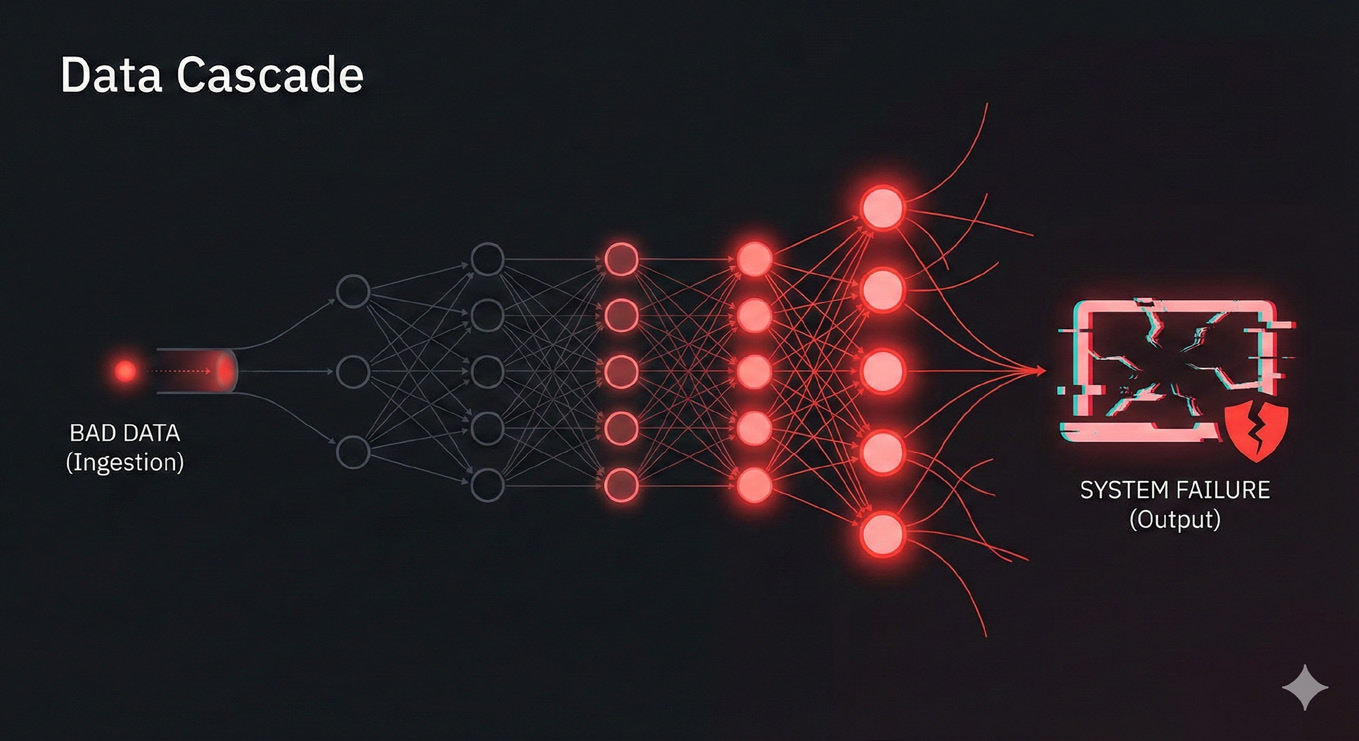
Implementing the quality standards demanded by the AI Act is undoubtedly associated with initial transaction and opportunity costs. But if you reduce the regulation to a pure cost perspective, you fail to recognise the fundamental information economics of the European single market. Insufficient data and system quality, however, massively jeopardises the realisation of this potential. The European Parliamentary Research Service (EPRS) has quantified in a far-reaching analysis that the absence of trust and fragmented rules cost the economy billions. Conversely, a uniform, ethically grounded quality and legal framework for AI could increase European gross domestic product by up to 294 billion euros by 2030. This economic potential, however, can only be unlocked if IT systems scale flawlessly. In stochastic machine-learning models, qualitative deficiencies compound drastically. What current AI research calls the data cascade describes the phenomenon in which marginal errors in the training data set grow exponentially and render the operational output unusable.¹⁰
When AI systems are used in critical business processes, the trust of end users and stakeholders is the only currency that enables scaling. Demonstrable conformity with the AI Act signals institutionalised reliability to the market. Compliance thus turns from a regulatory tax into a strategic investment in the trust premium that first makes European AI solutions marketable at all.¹¹
Conclusion: The paradigm shift to “trust by design”
The era of unregulated and purely exploratory AI development is drawing to a close. The EU AI Act marks not a singular bureaucratic act, but the beginning of a new phase of maturity in software engineering. For IT decision-makers, CIOs and data scientists, this means a mandatory methodological paradigm shift from a retrospective, reactive quality assurance to a proactive design principle called “trust by design”. This concept demands the structural integration of human values, legal norms and technical robustness as early as the requirements analysis of an IT project. Trust cannot be “patched” into an opaque neural network after the fact via a software update.¹²
The supposed obstacle that is the EU AI Act forces the European economy towards information-technology excellence. In an increasingly automated world in which algorithms make essential decisions, mere functionality is no longer enough. Digital trust is the license to participate in the market, and demonstrable quality is the hard currency with which it is paid. The IT departments of the future are no longer merely the suppliers of computing power and features; they are right now transforming into the institutional guarantors of trust.
Sources
- Siau, Keng; Wang, Weiyu (2018): Building Trust in Artificial Intelligence, Machine Learning, and Robotics. Cutter Business Technology Journal, 31(2), 47–53. In: cutter.com
- Veale, Michael; Borgesius, Frederik J. Zuiderveen (2021): Demystifying the Draft EU Artificial Intelligence Act — Analysing the good, the bad, and the unclear elements of the proposed approach. Computer Law Review International, 22, 97–112. DOI: 10.9785/cri-2021-220402
- Mökander, Jakob; Morley, Jessica; Taddeo, Mariarosaria & Floridi, Luciano (2021): Ethics-Based Auditing of Automated Decision-Making Systems: Nature, Scope, and Limitations. Science and Engineering Ethics, 27(44). DOI: 10.1007/s11948-021-00319-4
- Gudivada, Venkat N.; Apon, Amy & Ding, Junhua (2017): Data Quality Considerations for Big Data and Machine Learning: Going Beyond Data Cleaning and Transformations. International Journal on Advances in Software, 10(1&2), 1–20.
- Independent High-Level Expert Group on Artificial Intelligence (2019): Ethics Guidelines for Trustworthy AI. European Commission.
- European Union (2024): Regulation (EU) 2024/1689 (EU AI Act). Official Journal of the European Union. In: eur-lex.europa.eu
- Mehrabi, Ninareh; Morstatter, Fred; Saxena, Nripsuta; Lerman, Kristina & Galstyan, Aram (2021): A Survey on Bias and Fairness in Machine Learning. ACM Computing Surveys, 54(6), Article 115, 1–35. DOI: 10.1145/3457607
- Shneiderman, Ben (2020): Human-Centered Artificial Intelligence: Reliable, Safe & Trustworthy. International Journal of Human–Computer Interaction, 36(6), 495–504. DOI: 10.1080/10447318.2020.1741118
- Mittelstadt, Brent Daniel; Allo, Patrick; Taddeo, Mariarosaria; Wachter, Sandra & Floridi, Luciano (2016): The ethics of algorithms: Mapping the debate. Big Data & Society, 3(2), 1–21. DOI: 10.1177/2053951716679679
- Evas, Tatjana (2020): European framework on ethical aspects of artificial intelligence, robotics and related technologies — European added value assessment. Study published by the European Parliamentary Research Service (EPRS).
- Sambasivan, Nithya; Kapania, Shivani; Highfill, Hannah; Akrong, Diana; Paritosh, Praveen & Aroyo, Lora M (2021): “Everyone wants to do the model work, not the data work”: Data Cascades in High-Stakes AI. Proceedings of the 2021 CHI Conference on Human Factors in Computing Systems (CHI ’21), 39, 1–15. DOI: 10.1145/3411764.3445518
- Merchán-Cruz, Emmanuel A.; Gabelaia, Ioseb; Savrasovs, Mihails; Hansen, Mark F.; Soe, Shwe; Rodriguez-Cañizo, Ricardo G. & Aragón-Camarasa, Gerardo (2025): Trust by Design: An Ethical Framework for Collaborative Intelligence Systems in Industry 5.0. Electronics, 14(10), 1952. DOI: 10.3390/electronics14101952
Further reading: ISO/IEC 25010:2023 (Systems and software engineering — Systems and software Quality Requirements and Evaluation (SQuaRE) — Product quality model) and ISO/IEC TR 24028:2020 (Information technology — Artificial intelligence — Overview of trustworthiness in artificial intelligence).
Published in QualityNews H1/2026