Sustainability vs. Progress: Is AI an Environmental Problem?
AI offers enormous opportunities — but also causes considerable environmental impact. Are we opening a Pandora's box?
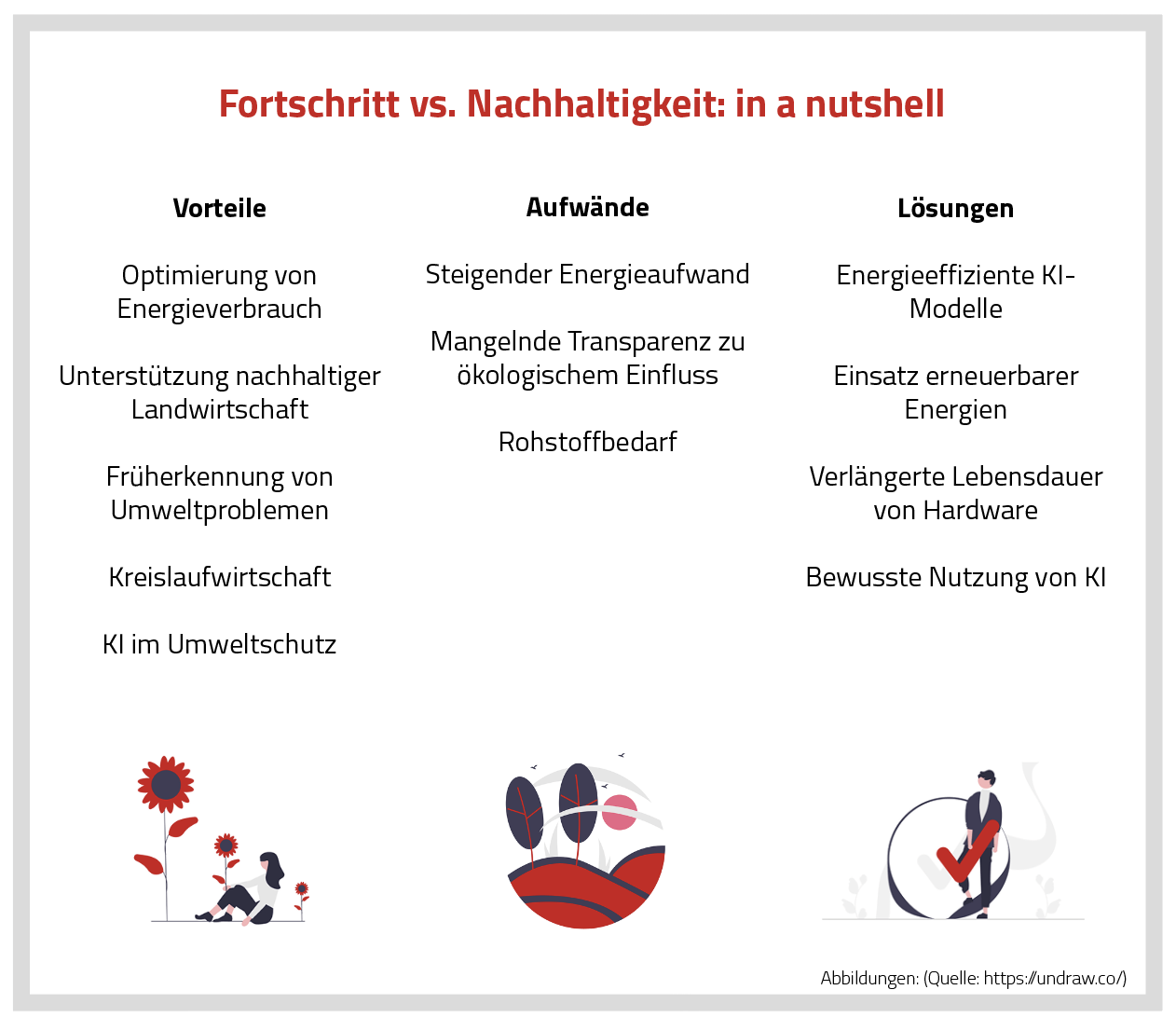
Artificial intelligence (AI) has developed rapidly in recent years and is increasingly permeating various areas of our lives. At the latest since the release of OpenAI’s text robot ChatGPT, AI has been on everyone’s lips. Whether in medicine, industry or everyday life — AI technologies offer enormous opportunities for efficiency gains and innovation. But the growing spread of these technologies also has a decisive flip side: it can cause considerable environmental impact. Are we thus opening a Pandora’s box with AI?
The development of artificial intelligence
The roots of artificial intelligence go back to the 1950s, when scientists began developing algorithms that imitate human learning and problem-solving behaviour. In recent decades, advances in computing power and the availability of large volumes of data (big data) have revolutionised machine learning and, in particular, deep neural networks (deep learning). Today, AI models are able to handle complex tasks, from image recognition to predicting the course of diseases. But the powerful algorithms require immense computing capacity, which leads to rising energy consumption.
In addition to these technological advances, the commercialisation of AI technologies has created an exponential demand for computing power. Companies and research institutions worldwide are investing in ever more powerful hardware to stay competitive. This has led to the emergence of huge data centres that require an uninterrupted power supply and cooling.
Why is AI therefore an environmental problem?
“Sustainability” has — unfortunately — degenerated into a buzzword. You find sustainability everywhere, on milk cartons just as on the labels of toys, on the advertising pages of airlines and even in software development. For a definition of sustainability, let us ask Wikipedia:
“Sustainability is a principle of action in the use of resources. It aims to ensure lasting satisfaction of needs by preserving the natural regenerative capacity of the systems involved, above all of living beings and ecosystems. The principle of sustainable action is a conflict of goals, a changeable best-possible state in which it is not possible to improve the target property of resource use without at the same time having to worsen the other property of resource preservation. In general, sustainability is understood today as a form of resource use that, according to the three-pillar model, rests on the simultaneous and equal implementation of environmental protection, long-term economic activity and fair coexistence, so that future generations too can live well.”
In short, sustainability is meant to ensure that ecological balance is preserved. An increasing use of resources therefore goes hand in hand with a disadvantage to that balance.
Now one asks oneself — data centres existed before, so why should this suddenly be so harmful to the environment?
AI is not a “finished program” that is developed once. It is meant to develop further, to learn, to be trained — independently, through the experiences with internet users, or through the targeted supply of test data. And that requires computing power and therefore energy. Independently of that, a query on ChatGPT, for example, consumes roughly ten times as much energy as a Google search.
“Data centres today consume four to five percent of global energy consumption,” said Ralf Herbrich, managing director of the Hasso Plattner Institute (HPI) in Potsdam and head of the department for Artificial Intelligence and Sustainability, to the news agency dpa. “There are estimates that consumption will rise to 30 percent in the coming years.”
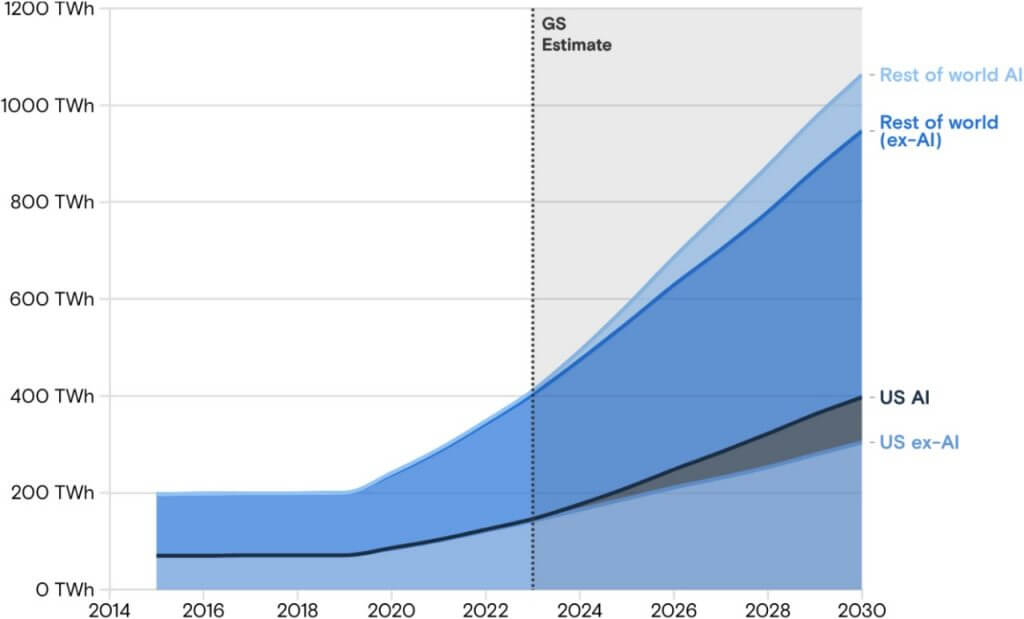
Source: Masanet et al. (2020), Cisco, IEA, Goldman Sachs Research
The environmental impact of AI technologies can be traced back to several factors:
1. Energy consumption of data centres
Modern AI applications are based on compute-intensive processes carried out in powerful data centres. These data centres require enormous amounts of energy, both to run the servers and to ensure the necessary cooling. Training OpenAI’s “Generative Pre-trained Transformer 3” (GPT-3) language model, which uses deep learning, required for example 1,287 megawatt hours of electricity — the equivalent of a small town’s consumption over several months (example: Klein-Neusiedl; approx. 1,000 inhabitants). The resulting CO2 emissions corresponded to about 700 return flights from Vienna to Dubai. Its successor, GPT-4, required 6 months of training and consumed as much as 7,200 megawatt hours — 5.5 times that of its predecessor! Google wants to be net climate-neutral by 2030. For this reason, AI data centres are to be powered in future by small modular nuclear power plants; by 2035 the annual output is to reach 500 megawatts. Sustainability through nuclear power?
2. Resource consumption and CO2 emissions
Manufacturing the hardware for AI systems requires rare earths and other raw materials, whose extraction is often associated with considerable environmental damage. In addition, operating AI models generates considerable CO2 emissions, especially when the electricity comes from fossil sources. Even in regions with renewable energy there is the problem that rising electricity demand could slow down the energy transition. A study by the University of Massachusetts found that training a single large AI model can emit more than 284 tonnes of CO2 — the equivalent of five times the CO2 output of an average American car over its entire lifetime.
Another problem is water consumption. Data centres require large amounts of water for cooling, which can lead to serious water shortages in dry regions. A current topic in this respect are the wildfires in Southern California, which have been raging since 7 January 2025, where the water shortage causes considerable problems in fighting the fires. Ironically, large data centres are also located in California, for example those of Google, which additionally strain the groundwater.
3. E-waste and short innovation cycles
Technological advances mean that hardware components have to be replaced ever faster. Old servers, processors and GPUs are discarded, which leads to growing electronic waste. Since many of these materials are difficult to recycle, additional environmental problems arise. Moreover, the life cycles of AI technologies are often very short. New models and algorithms often require specialised chips that quickly make older generations obsolete. This leads to an even faster replacement of hardware, which further increases resource consumption.
Benefit and cost of AI from an ecological perspective
AI technologies can, however, also contribute to solving environmental problems. The question therefore arises whether the benefit outweighs the ecological damage.
Benefit of AI for the environment
- Optimising energy consumption: AI can help control power grids more efficiently and reduce energy consumption in companies and households.
- Sustainable agriculture: Through precise analyses, AI models can help farmers use water and fertiliser more efficiently.
- Early detection of environmental problems: AI-supported sensors can identify environmental changes early and predict disasters such as wildfires, earthquakes or tsunamis.
- Circular economy: AI can optimise material flows and thus improve recycling processes.
- AI in environmental protection: Google itself uses AI via its company DeepMind to reduce the energy consumption of its data centres by 40 %.
Costs and risks
Rising hunger for energy: Advances in AI mean that ever more powerful models have to be trained, which further increases energy demand.
Lack of transparency: So far there are few standards for the sustainability of AI applications, which makes it difficult to assess their ecological impact.
Dependence on raw materials: The rising need for high-performance hardware increases demand for rare earths and other critical raw materials.
Approaches towards a sustainable AI
To defuse the tension between progress and sustainability, various measures are necessary:
Energy-efficient AI models
Research into more efficient algorithms can help reduce the computational effort. For example, predictive models can contribute to saving energy, or more economically programmed neural networks can be used.
Use of renewable energies
Data centres can increasingly rely on renewable energies to minimise their CO2 footprint. Some tech companies are already investing in sustainable power sources, but there is still much potential here.
Extended hardware lifespan
Through recycling and reuse, valuable raw materials can be saved. Companies should also opt for more durable hardware and extend the innovation cycles.
Conscious use of AI
Not every application has to be based on complex neural networks. Often simpler, less compute-intensive models are enough to accomplish a task. Companies should check in which cases a resource-intensive AI is really necessary.

Source: x.com
Do we really have to ask an AI every time we look for something? And even when we do not ask an AI, do we really have to open a search engine? Do encyclopaedias, dictionaries and atlases really no longer have any right to exist?
Regulation and transparency
Policymakers can develop sustainability standards for AI and oblige companies to disclose their environmental impact. This could foster more sustainable innovations.
Outlook: The future of sustainable AI
Is AI, seen this way, an environmental problem? The answer is: yes. But it is a problem that can be counteracted, and the debate about it should be intensified and improvements urgently developed. A sustainable AI is possible — but it requires conscious action and a long-term strategy. Only in this way can it be ensured that progress does not come at the expense of the environment, but stands in harmony with it. And for that we must first of all question our own attitude towards AI. Do we want to use ChatGPT just because it is currently “in”? Do we really have to buy a “smart” thermostat? Or is it enough to take the few steps to the radiator ourselves, and to look something up in an encyclopaedia while doing so?
Sources and further information
- Wikipedia: “Nachhaltigkeit” — de.wikipedia.org
- Masanet et al. (2020); Cisco; IEA; Goldman Sachs Research
Originally published at SEQIS Blog