Local AI: Advantages and Disadvantages
When running AI on your own hardware pays off — and when the cloud stays the better choice

Artificial intelligence (AI) is no longer a topic of the future — it is part of our everyday work. Most of the time we use AI in the cloud, that is, via the services of large providers. But increasingly the question is being asked: shouldn’t AI also be run locally? This so-called Local AI brings interesting advantages, but also clear challenges.
What does Local AI mean?
Local AI refers to running AI models directly on your own hardware — for example on company servers or powerful workstations — instead of in an external cloud. These can be small language models running on a laptop, or more complex solutions on servers with strong GPU support.
Advantages of Local AI
- Data security & privacy — Sensitive data never leaves your own company / sphere of control. This eliminates the risk that information could be stored or analysed by cloud providers.
- Independence from external hosting partners — No dependence on pricing models and their changes, usage limits or possible outages of external services.
- Offline functionality — Local AI can also be used without an internet connection — e. g. in isolated networks or in mobile deployments.
- Speed — Since no transmission to the internet is necessary, network latencies are eliminated.
- Adaptability — Models can be trained specifically on your own data (fine-tuning). This allows individual, consistently identical solutions that a cloud service cannot cover.
Disadvantages of Local AI
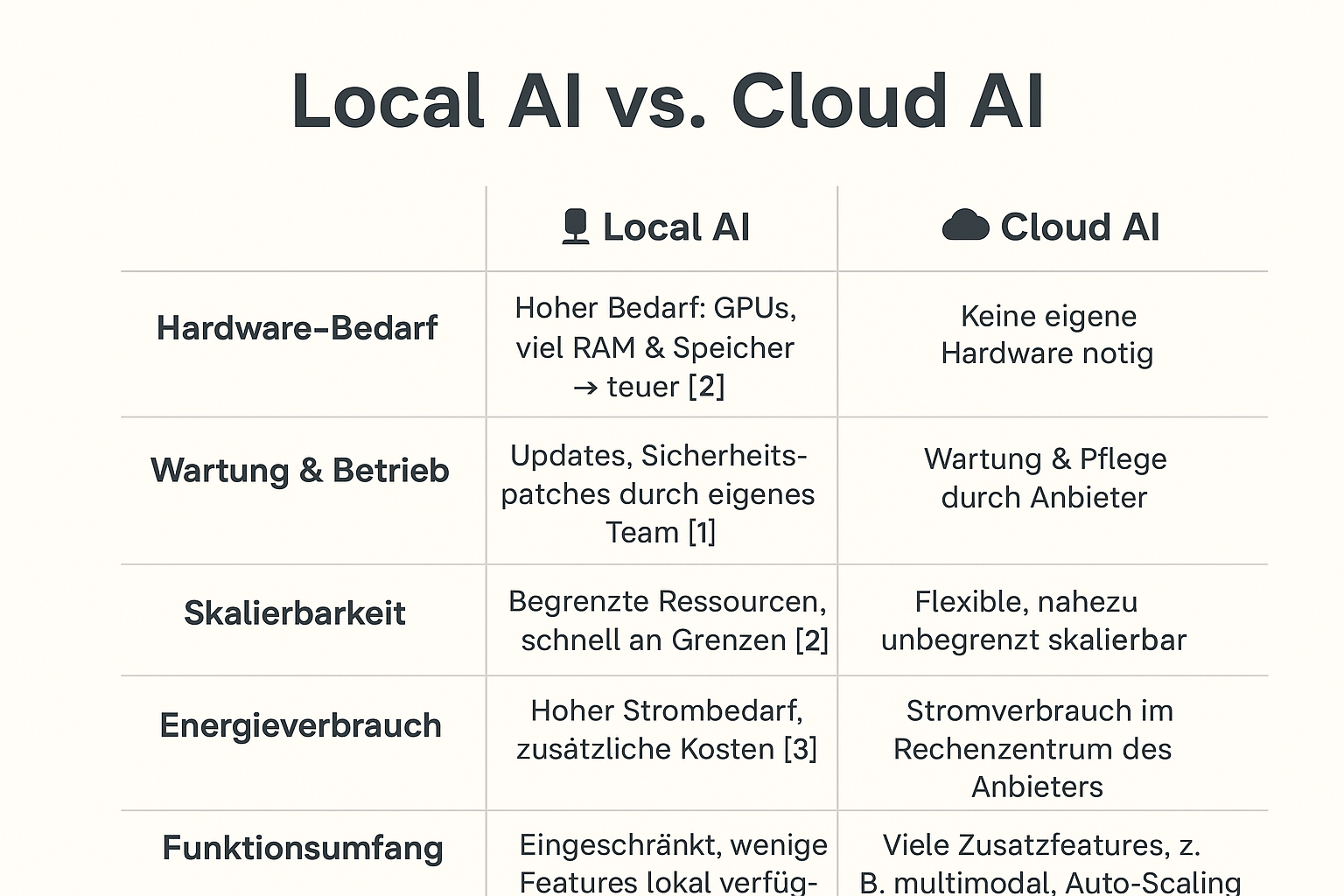
- High hardware requirements — Modern language models need GPUs, plenty of RAM and storage. This investment is expensive.
- Maintenance & operation — Updates, security patches and model upkeep are the company’s responsibility.
- Limited scalability — While cloud services provide resources flexibly, local hardware quickly reaches its limits when many users access it simultaneously.
- Energy consumption — Running it yourself means additional power demand and therefore higher operating costs — though these would have to be weighed against the external costs.
- Feature scope — Many cloud services offer features (e. g. multimodal models, automatic scaling) that are difficult to make available locally.
When is Local AI worth it?
Local AI is particularly suitable for organisations where data protection and control are paramount — e. g. in healthcare, in banks or in public authorities, or for companies that place high value on repeatability and stability.
For companies without high security requirements or without large hardware resources, the cloud is often more practical and cheaper.
Conclusion
Local AI is not a replacement for cloud offerings, but a complement. In many scenarios a hybrid approach will be the best solution: confidential data is processed locally, while general use cases remain in the cloud. This way companies benefit from both worlds.
Sources and further information
- Heise Online: “Lokale KI-Modelle im Einsatz” (2024)
- Gartner Report: “AI Infrastructure Trends” (2023)
- Open Source Initiative: “On-Premise AI and Privacy” (2023)
Originally published at SEQIS Blog