AI in Project Management
How artificial intelligence supports project managers — use cases and outlook
Introduction
More and more often, one hears about the use of artificial intelligence (AI — in German: Künstliche Intelligenz, KI) in many different subject areas. This is frequently seen in direct connection with software development.
The field of application for AI is, however, much broader, because nowadays data is captured digitally in almost all areas of activity.
Accordingly, it is possible to use AI almost everywhere in order to employ the data used for it as efficiently as possible. The derivation and development of use cases can also, where appropriate, be carried out with the help of structured methods, such as the “five-stage method for developing organisation-specific AI use cases” presented in the article “Developing Purposeful AI Use Cases — A Structured Method and Its Application in Project Management” [1].
Companies will use AI in project management at an ever-increasing rate to gain support in the way they create, manage and operate or steer projects.
Integrating AI into project management enables more efficient resource management, improved decision-making, proactive risk management and an overall increase in project performance.
This article takes a look at the application of AI in project management and examines how this technology can help project managers achieve their goals more effectively. We will illuminate various aspects, including automated task management, real-time monitoring, predictive analysis, intelligent communication and agile planning.
In particular, the focus here will be on presenting the use cases, as well as prompting a discussion about the possible changes for a project manager.
Use cases for the deployment of AI in project management
In this chapter we will look at the concrete applications of AI in project management. From intelligent decision-support systems to the automation of routine tasks, these use cases offer exciting insights into the transformative power of AI in project management.
A particularly strong potential lies in the fact that AI can quickly carry out time-consuming, repetitive tasks, as well as swiftly perform analyses over a large volume of data. This allows project managers to place more focus and time on strategic decisions, as well as decisions that can only be made through human knowledge [2].
Most companies have already integrated team-communication and messaging tools that can by now be supported by AI chatbots (as well as further implementations). These can take over simple, repetitive tasks, such as support with scheduling or sending activity reminders to team members.
Furthermore, they can trigger alerts, based on individual employee tasks, that are sent to management when activities begin to deviate from the original plan. In addition, they have the ability to send out early warnings when they uncover budgeting or planning problems that potentially pose a risk to project delivery [3].
These chatbots can in part also be deployed autonomously, when they are given the necessary insight into processes, flows and data. In doing so, they can show their strong potential in pattern recognition and the detection of anomalies.
It remains important to note that the deployment of this technology increasingly moves in the direction of predictive analysis and is not to be understood like classic threshold alerting.
For this it must be ensured that the tool deployed has access to the necessary information sources, such as project management, budgeting, activity and documentation tools.
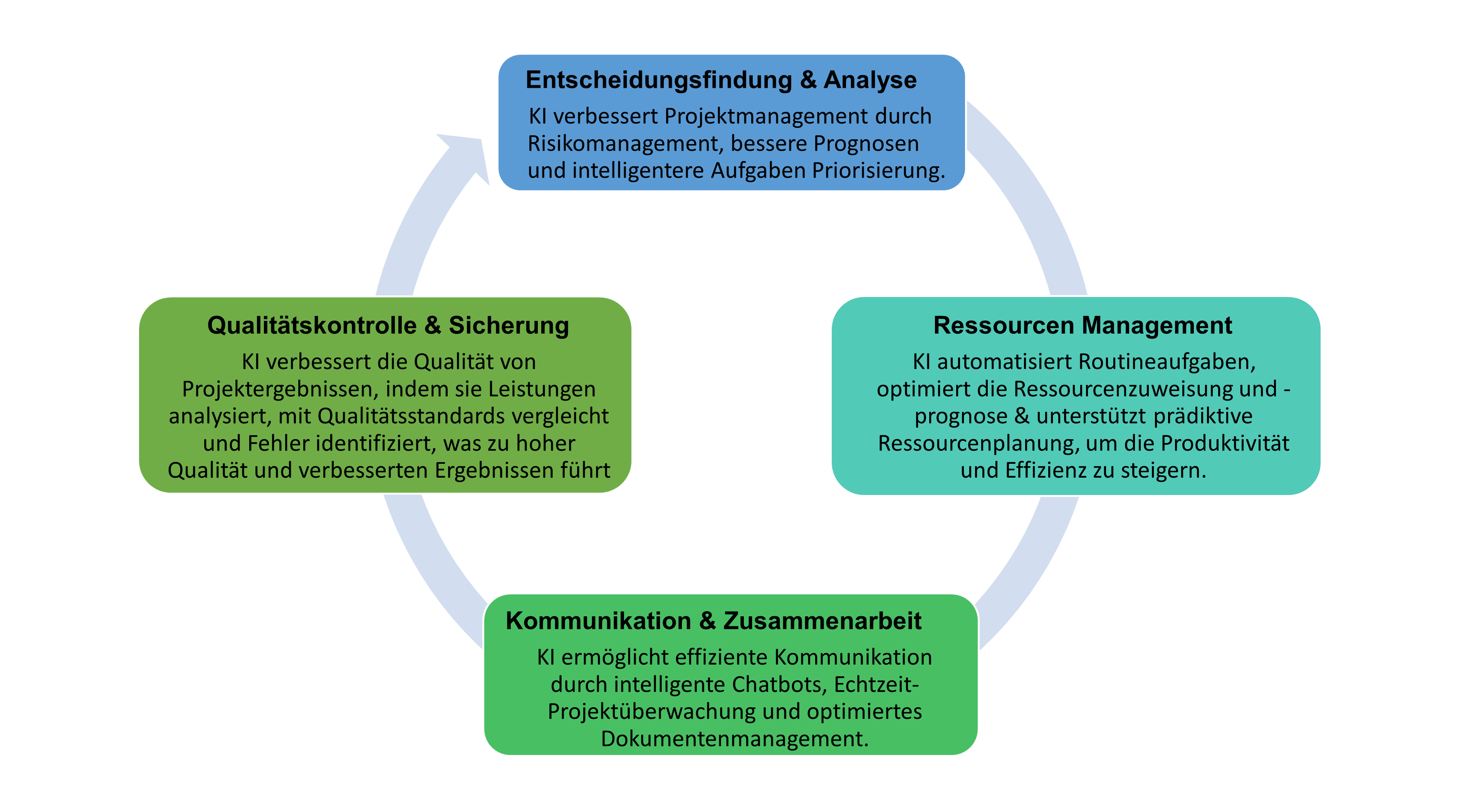
The individual use cases identified were grouped into 4 broad overarching categories:
- Decision-making and analysis
- Resource management
- Communication and collaboration
- Quality control and assurance
Let us now come to the details of the individual use cases.
1. Decision-making and analysis
Improved decision-making
AI makes it possible to make well-founded decisions by analysing large datasets and recognising patterns, risks and opportunities. By using machine-learning algorithms, AI can process historical project data, recognise trends and create predictive analyses. In this way, project managers can make data-driven decisions, which leads to more accurate forecasts and better project results.
Suppose a project manager faces the challenge of planning the deployment of resources for a complex construction project. With the help of artificial intelligence, the project manager can analyse historical project information such as past construction projects, resource availability, weather conditions and other factors.
By analysing this data, the AI can identify patterns and correlations. For example, the AI might recognise that certain weather conditions have an impact on the workers’ performance, or that certain materials frequently cause bottlenecks. Based on these insights, the AI can carry out predictive analyses to forecast the course of the project and identify possible risks and bottlenecks.
Based on this information, the project manager can make well-founded decisions. They can, for example, adjust resource planning to avoid bottlenecks, consider alternative materials, or prioritise alternative activities in the event of unfavourable weather conditions. Through data-based decision-making, the project manager can improve the project’s chances of success and reduce the likelihood of delays or cost overruns.
Intelligent risk management
Recognising and managing risks is of great relevance to the successful execution of projects. AI can help project managers with risk detection and mitigation by analysing historical project data, identifying risk patterns and predicting potential risks. AI algorithms can continuously monitor project activities, detect deviations from the expected results and alert project managers to potential risks in real time. This proactive approach ensures timely risk-minimisation strategies and improved project success rates. [4]
Agile planning and forecasting
By analysing historical project data and taking external factors such as market trends into account, AI algorithms can create more accurate and more realistic project schedules and forecasts. In this way, project managers can set realistic goals, deploy resources effectively and adapt promptly to changing project conditions.
For example, delivery dates for a project could change and the need might arise to find alternatives to replace undeliverable goods. Likewise, it can be helpful for the AI to provide information about changes in legislation that may have to be mandatorily observed, and thus make a re-prioritisation of tasks necessary, or even require that more resources be added to the project — for example, bringing suitably qualified employees into the project in a timely manner.
Intelligent task prioritisation
AI can analyse project requirements, deadlines, dependencies and resource availability in order to prioritise tasks intelligently. By taking various factors into account, AI algorithms can suggest the most critical and most time-critical tasks and thus ensure that project teams concentrate their efforts on high-priority activities. This helps project managers optimise their workflows, meet deadlines and achieve project goals efficiently.
2. Resource management
Automated task management
AI can automate routine tasks so that project managers and team members can concentrate on higher-value activities. Everyday tasks such as scheduling, time tracking and progress reporting can be automated with AI-supported project-management tools. This not only saves time and effort, but also reduces the risk of human error, which leads to higher productivity and efficiency. [5]
Intelligent resource allocation
One of the biggest challenges in project management is resource allocation. With the help of algorithms, this process can be optimised by evaluating various factors such as resource availability, qualifications and project requirements. By taking these variables into account, the most efficient allocation strategies can be suggested to ensure that resources are used effectively and productivity is maximised.
Intelligent resource forecasting
From the historical data of previous projects and resource allocations, forecasts can also be derived.
An example: suppose a project manager is responsible for the planning and implementation of a marketing campaign for a new product. The AI can analyse which marketing channels were successful in the past, how the target group behaves and which resources were needed for similar campaigns. Based on this information, the AI can predict which resources — such as graphic designers, copywriters and social-media experts — will be needed for the future project.
Predictive resource planning
AI algorithms can predict future resource availability and requirements on the basis of historical data, employee schedules and project requirements. By taking factors such as holidays, absences and other commitments into account, AI can help project managers recognise potential resource bottlenecks and plan the project schedules accordingly. This proactive approach minimises resource bottlenecks as well as overbooking, reduces project delays and optimises the entire project execution.
3. Communication and collaboration
Natural language processing and communication
Efficient communication is of central importance in project management. AI technologies, such as the automatic processing of natural language, enable intelligent chatbots and virtual assistants that can understand and answer a project manager’s project-related queries. These AI-driven communication tools facilitate efficient collaboration, streamline the exchange of information and provide immediate support to project stakeholders, thereby improving communication and reducing delays.
Real-time project monitoring
AI-supported project-management tools can monitor project activities in real time by collecting data from various sources, e.g. from task progress, from team-collaboration platforms and from communication channels. By analysing this data, AI algorithms offer project managers a comprehensive insight into project status, bottlenecks and potential problems. Real-time monitoring enables proactive decision-making, timely intervention and the ability to keep projects on course.
Intelligent documentation management
Project documentation plays an important role in project management, and AI can optimise and improve this process. AI algorithms can automatically categorise and organise project documents, extract relevant information and provide intelligent search functionality. AI-supported document-management systems can also detect potential gaps or inconsistencies in the documentation and ensure that project teams can access accurate and up-to-date information when needed.
4. Quality control and assurance
AI-supported quality-control mechanisms can analyse project deliverables and compare them with predefined quality standards and benchmarks. By using techniques such as image recognition and natural-language processing, AI algorithms can automatically assess the quality of project results, identify errors or inconsistencies and deliver actionable feedback. This supports project teams in maintaining high quality standards and delivering error-free results.
What can this look like in practice
At the current time, more and more tools are emerging that have an additional AI assistant built in and are thus meant to support the editing of documents and, for example, the planning of projects. Because of the multitude of tools on offer, I would like to mention one at this point that I have personally already come into contact with. Should other prerequisites be necessary for different areas, it can be helpful to know a tool name from which to start a search for alternatives.
Notion Projects [6] — is a connected tool that supports the entire project workflow and makes AI available to each individual user. Notion’s unique advantage is its connectivity with other tools, such as the ability to preview Google Drive and Figma files, integration with GitHub for tracking product and development teams, and with Slack to inform teams about project news and changes.
AI is included in Notion to automate various tasks in different project phases. AI autofill / AI writing assistant enables the creation of summaries, meeting follow-ups and keeps project information up to date as it progresses.
Summary — change for project managers
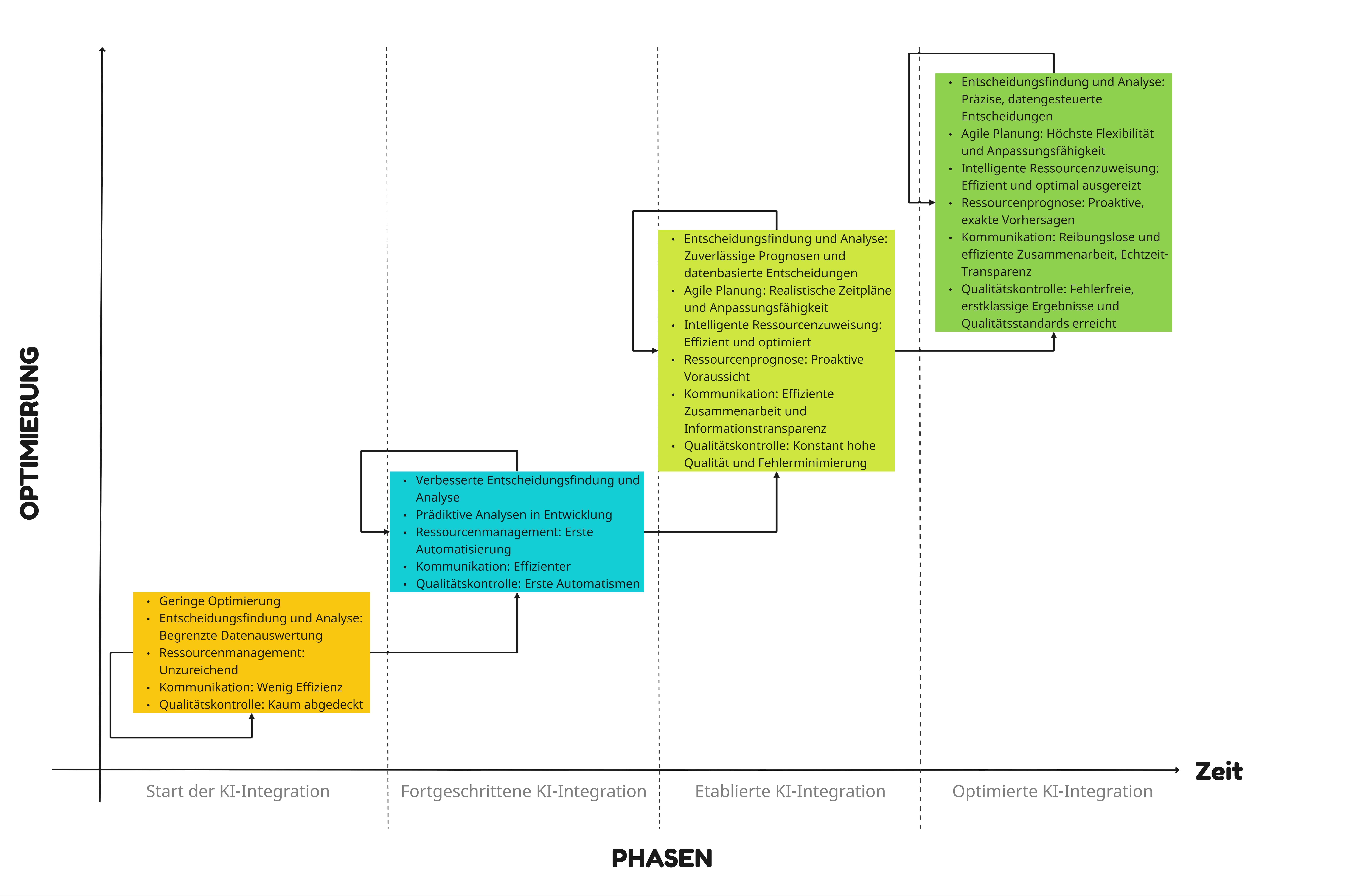
Integrating AI into project management brings numerous benefits, including improved decision-making, optimised resource allocation, higher productivity, improved risk management, efficient communication as well as more precise planning and forecasting. While AI cannot replace human expertise and judgement, it complements and empowers project managers to carry out projects more effectively and efficiently. As AI advances further, project managers who make these technologies their own will gain an additional advantage in an increasingly complex and dynamic business environment.
Conclusion: project managers cannot be replaced so easily; the human component plays a very large role in a great many projects, one that cannot be replaced so easily by artificial intelligence in order to compete on an equal footing.
However, a lot of repetitive work can be taken off their hands, leaving them more time to devote to further planning as well as to solving problems in projects.
Here is a short list of tools and names that came up in the course of the research. They were, however, not checked for their functionality or the extent of their support. The listing serves merely as information and a starting point for possible research into tools and alternatives.
- Rescoper — an AI-based project-management software. [7] Munir, Maria. “How Artificial Intelligence Can Help Project Managers.” (2019). — globaljournals.org
- Clickup — cloud-based collaboration and project-management tool, suitable for companies of all sizes and industries.
- Polydone — a project-management platform for agile teams.
Originally published at SEQIS Blog