Dimensions of Reality: What is AR?
A journey into the world of Augmented Reality — between utopia and dystopia

Living in the Matrix… The film from 1999 already paints a dystopian world that nonetheless embodies a fascinating idea. Ever since there have been machines, we have naturally also asked ourselves about the limits and possibilities of our technological progress. The tetralogy around the Matrix is one of the most popular, though not the first, work to deal with human souls in a digital world. Many other works with a similar approach have since emerged. But what if we reversed this notion? What if it is not we who live in a digital world, but rather the digital world that finds an echo in our real world? Welcome to the world of “Augmented Reality” — a world in which the real and the digital combine in a fascinating and useful way, far removed from any dystopia. This short excursion addresses the questions of what? when? how? and what for?, in order to develop a solid basic understanding of this technology and to form your own picture of how near or far we are from a digital dystopia — or even a utopia!
AR — what does this acronym mean?
AR stands for “Augmented Reality” and denotes a technology that embeds digital content into the real world. It is a kind of artificial reality that goes beyond natural seeing and perception. The word “augment” can be roughly translated as “to enlarge” or “to extend”, which means that “Augmented Reality” in German means something like “extended reality”. AR uses various types of sensors, cameras and computer chips to transmit this digital content in real time. This content can be images, animations or even interactive elements such as buttons or controls. For this, the camera of a device is used, for example, to capture the surroundings and project virtual controls onto them.[1]
When was this technology developed?
The idea of AR emerged as early as the 1960s, when Ivan Sutherland and Bob Sproull developed the first AR application at the University of Utah. The application, named “The Sword of Damocles”, projected digital information into the real world and allowed the user to augment the world around them.[2] At that time, however, the technology was not yet mature, and further developments were needed to put it into practical use.
Only in the 1990s did the technology and the hardware reach a point at which various AR systems could be further developed by researchers and companies, such as the “Virtual Fixtures” by Louis Rosenberg in the 1990s.[3]
The commercial breakthrough began in the 2010s with the introduction of smartphones and tablets. The release of the AR app “Pokémon Go” in 2016 led to broad acceptance and popularity of AR applications, also among the general public.
The history of AR is by no means fully told, however. With advances in hardware and software, new opportunities are continuously opening up. As a result, these binary numbers will have ever more possibilities to exert an influence on various areas of our daily lives.
How does the linking of the two worlds work?
To enable a successful linkage, the “digital” world first needs a representation of the “real” world that is to be augmented. The second component of this recipe consists of the digital object, be it a button, an image or an animation. To establish the actual connection, various variants are available, which are briefly outlined below:
Markerless AR
This is probably the simplest variant, in which the camera image is used unchanged. With the help of algorithms that can recognise objects, a rough estimate is made of what is in the camera image. A digital object is then projected into the camera image. A well-known example of this is Pokémon Go, in which a Pokémon can simply be “placed” in the living room and the trainer can interact with it — at least in the ideal case. However, it can happen that the Pokémon is suddenly displayed so large that it takes up the entire screen, or that it cannot be placed correctly at all. This illustrates a disadvantage of this variant: depending on the lighting conditions, the position of the camera and the objects recognisable in the image, it can be difficult to calculate realistic 3D proportions. The respective app may make wrong assumptions, or the process does not work correctly from the outset due to inadequate estimates.[1]
Marker-based AR
Marker-based AR, as the name already suggests, uses information about so-called “markers” in addition to the data that the camera image provides. These markers are usually 2D objects such as fixed QR codes, serial numbers or fixed objects that can provide additional information, such as orientation in space, the dimensions of an object, or the possibility of direct interaction on site — for example, playing music or opening a website. It is therefore possible to call up or link digital content such as a website from the real world via a QR code. In many areas, the boundaries between the real and the digital world become blurred. If, for example, I open a QR code on my phone to share a Wi-Fi password and someone else scans it with their smartphone, this can strictly speaking also be regarded as “AR”, even if the real interaction is very brief and most of it takes place digitally.[1]
Layered AR
Layered AR is ultimately an extension of the “marker-based” variant. Here too, the information provided, for example, by the smartphone camera is extended by a “layer”. This means that significantly more information is available. For example, with the help of the location, the spatial orientation of the phone and the additional layer of a city map (layer), real-time navigation can take place over the camera image.[1]
Projection AR
In this variant, the principle is reversed again: instead of using data from the real world to obtain digital content, the technology is used to enable real interactions. In simplified terms, this involves projections of holograms that imitate a real object, such as a keyboard. When this hologram is interacted with, the keyboard behaves like a “real” keyboard, even though it has no physical keys.[1]
What can AR be used for?
In short, AR is used in many areas. There are infinitely many examples, from games to medicine, advertising, office work, archaeology, education and even art. Ever spontaneously bought admission tickets for the museum at the Belvedere? No? Here is a quick tip for spontaneous people: the QR code is located right next to the entrance door and saves long waiting times, even if you are already on site. During the days of Corona, the same technique could even be used to spontaneously book vaccination appointments on site. The metaverse has already shown what remote work can look like by providing digitally well-equipped office spaces without having to give up your love of flipcharts, real “stand-ups” and whiteboards. “VR Tube” even allows introverted and camera-shy people to shoot videos in front of the camera without really having to show themselves. These are just a few brief examples. In the article “The fascinating world of Augmented Reality: inspiring examples for immersive experiences” you will find further examples with more detailed descriptions.
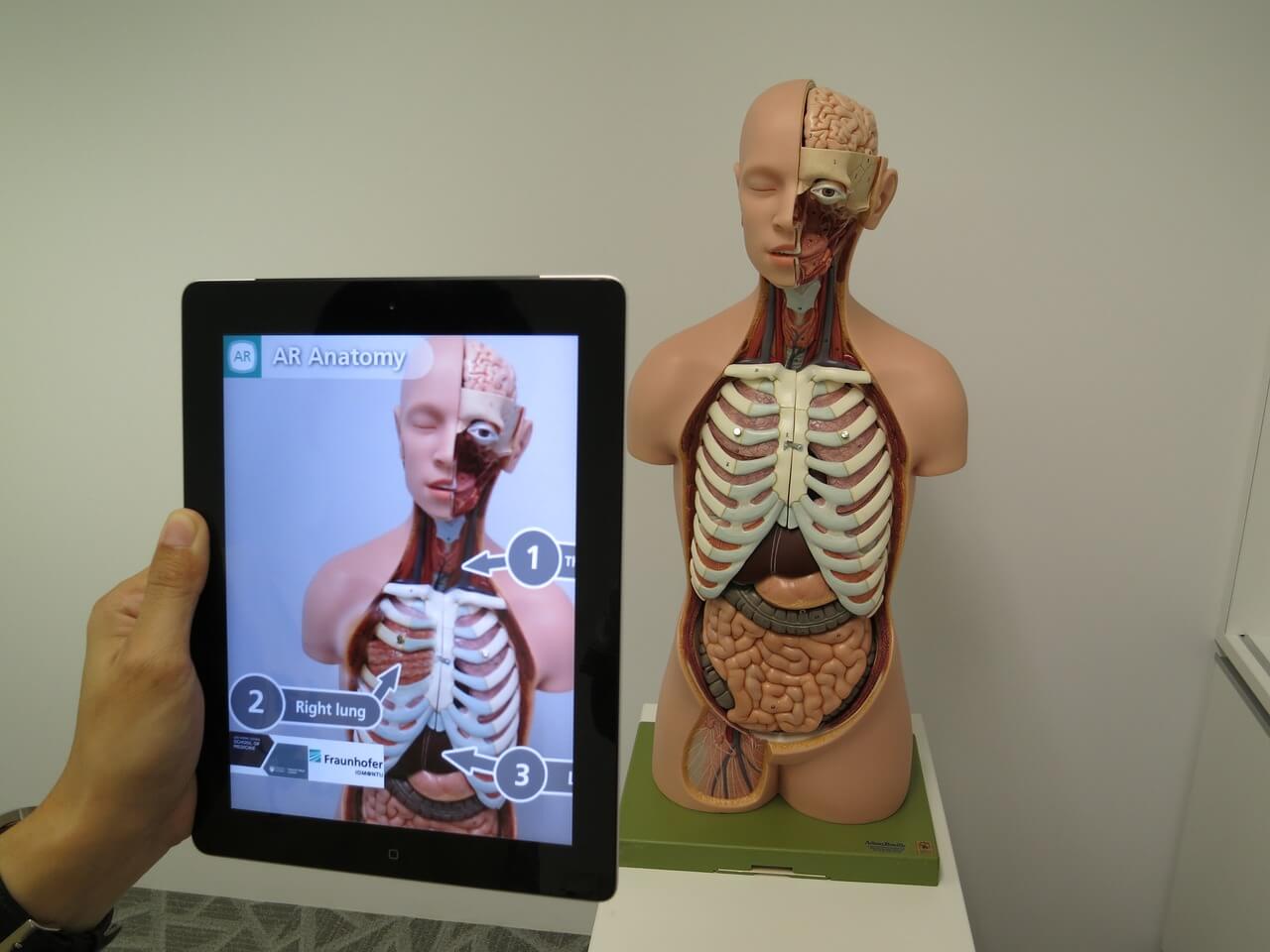
Image by zedinteractive on Pixabay
Utopia or dystopia?
As a conclusion, one can say: neither. There is a multitude of fascinating possible applications that can undoubtedly make everyday life easier in many areas. Nevertheless, Augmented Reality will not solve the world-shaking problems such as wars or the climate crisis. An enslavement of humanity within a simulation is likewise far away. Whether the technology offers added value for our society or can become a danger lies, as with many things, in the hands of the users. Our human technology can work wonders in medicine, but can also destroy livelihoods in war. It is up to us to decide in which future we want to live and in what way we will get there.
Sources and further information
[1] Augmented Reality (AR) — Definition (Lifewire)
[2] Sutherland, I. E. (1968), “A head-mounted three dimensional display”, Proceedings of AFIPS 68, pp. 757–764
[3] L. B. Rosenberg (1992), “The Use of Virtual Fixtures As Perceptual Overlays to Enhance Operator Performance in Remote Environments”, Technical Report AL-TR-0089, Wright-Patterson AFB OH: USAF Armstrong Laboratory
Originally published at SEQIS Blog