Thinking in Spite of AI: Why Automation Must Not Replace the Mind
How we stay critical when machines deliver seemingly perfect answers
AI tools make our everyday work enormously easier. But the more we use them, the greater the danger of unlearning how to think for ourselves. This article explores the question of how we stay critical when machines deliver seemingly perfect answers.
Planning, designing, arguing and implementing can now be done precisely and efficiently with AI tools such as ChatGPT, Copilot or Gemini. What used to take hours, the AI does in seconds. Yet the more we rely on these systems, the more the danger grows that we unlearn how to think for ourselves. Technological progress makes many things easier, but it can also lead us to unconsciously hand over responsibility for our own judgement.
The article explores the question of how we can stay critical and independent despite the convenience of modern automation, and why this is decisive for the future of work.
From Relief to Mental Inertia
Automation has always been a synonym for efficiency. Machines replaced physical labour, software accelerated processes, and now AI is beginning to relieve thinking itself.
Texts are formulated automatically, meetings transcribed and solution paths prepared. This support saves time, but can also bring risks. We get used to the comfort of no longer having to analyse, question or weigh things up ourselves.
Psychologically speaking, this is called cognitive inertia — the tendency to fall back on existing patterns of thought or convenient routines instead of actively thinking. When AI delivers plausible answers to us, thinking often seems superfluous. Yet this is precisely where the danger lies. A mind that is not trained loses its sharpness.
Fast and Slow Thinking
The psychologist, behavioural researcher and Nobel laureate Daniel Kahneman distinguishes, in his book “Thinking, Fast and Slow”, between two modes of thinking that shape our behaviour:
- System 1 is intuitive, fast, automatic and emotional.
- System 2 is slow, reflective, analytical and conscious.
Artificial intelligence appeals above all to our System 1. It delivers results immediately, elegantly formulated and mostly convincing. As a result, its answers activate our intuitive thinking, and we often accept them without thoroughly examining them.
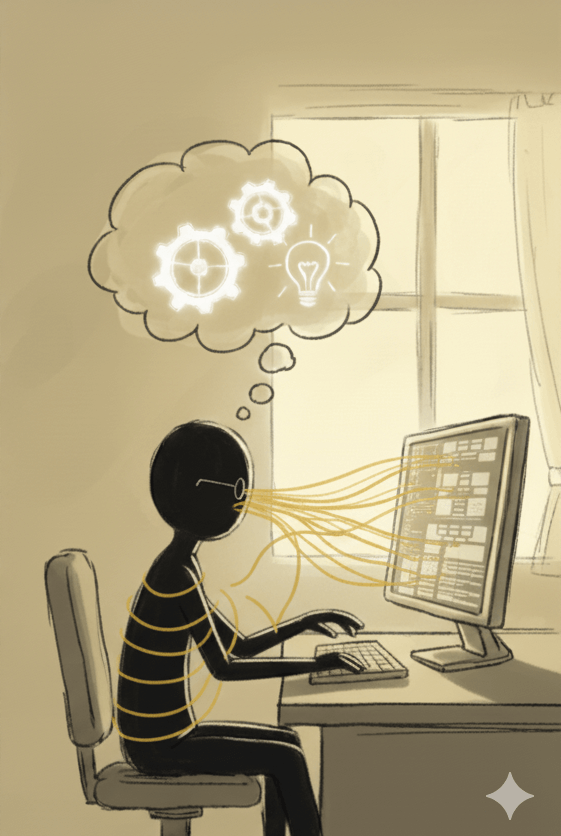
System 2, which is responsible for critical analysis and deep understanding, frequently remains inactive in the process. Slow thinking is exhausting, but essential. It protects us from misjudgements and premature conclusions. When AI amplifies our fast thinking, we must consciously find ways to encourage slow thinking.
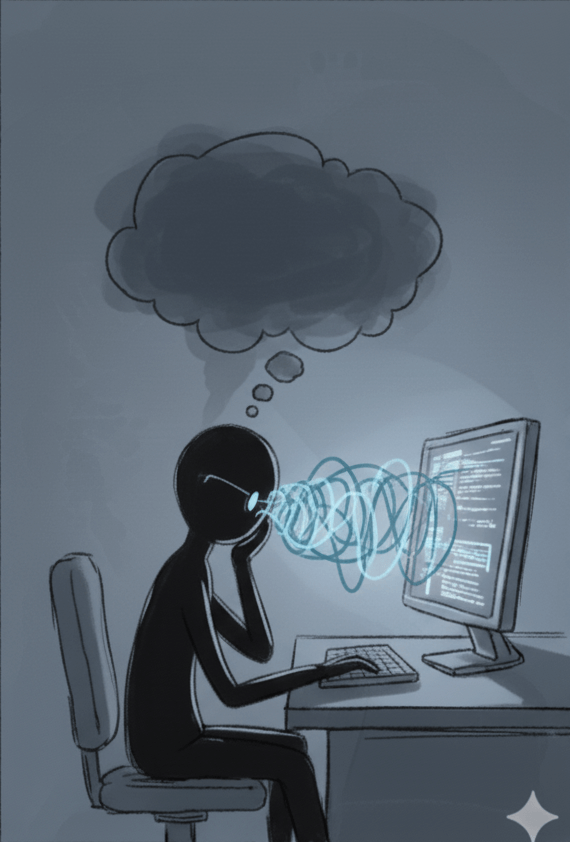
Many people, however, tend to blindly trust the statements of automated systems. But AI does not deliver absolute truth; it delivers probabilities based on patterns in the underlying data. This trust can lead to automation bias: we often adopt AI recommendations unexamined and neglect our own assessments, even when the suggestions are erroneous or incomplete.
In practice this means: whoever relies too heavily on AI risks that important aspects are overlooked or wrong decisions are made. Conscious questioning and critical examination remain indispensable in order to use the strengths of AI effectively without losing one’s own power of judgement.
Critical Thinking as a Key Competence
In an increasingly automated working world, critical thinking is becoming a central skill. It is not about distrusting AI, but about using it consciously and reflectively.
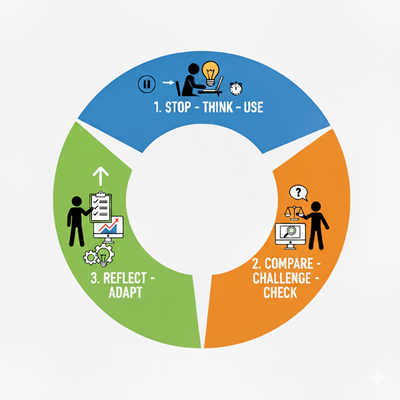
A simple procedure can help to anchor this attitude in everyday work.
1. Stop – Think – Use
Before deploying the AI, you should pause briefly. What do I really want to know? What kind of answer do I need? Consciously formulating a question prevents you from handing over control of the thinking process.
2. Compare – Challenge – Check
After the result, you should examine the answer. Are there alternative sources or perspectives? What assumptions are embedded in the answer? Are the figures, arguments and conclusions correct? This way the human stays in dialogue with the machine and does not become its passive user.
3. Reflect – Adapt
After use, reflection is important. What worked, what did not? This conscious review strengthens judgement in the long term and prevents you from unconsciously adopting AI results.
To implement this procedure better, you can use so-called pre-prompts. A pre-prompt is a kind of “meta-instruction” or rule of behaviour that you place ahead of the task. With it, you define the role or the goal of the AI’s answer before you ask the actual question.
Example from software development: “Help me understand the pros and cons of different data structures. Show me possible lines of reasoning without proposing finished code. I want to arrive at the decision myself.”
Conclusion
Automation is an enormous relief, but it must not lead to mental dependence or impoverishment. If we understand AI not as a replacement but as a tool, and establish routines that train our judgement, it can help us to think more consciously. This way the mind stays alive, even in an increasingly automated world.
Sources and Further Information
- Kahneman, D. (2011). Thinking, Fast and Slow.
- https://www.gizmodo.de/kollaborative-intelligenz-wie-man-mentale-traegheit-vermeidet-und-die-formel-mensch-ki-staerkt-2000027399
- https://cset.georgetown.edu/publication/ai-safety-and-automation-bias/
- https://biases.de/automation-bias/
- https://stealthesethoughts.com/2025/07/22/stop-ai-hijacking-your-thinking/
- https://www.resilienz-akademie.com/resilienz-allgemein/metakognition/
- https://www.forbes.com/sites/charlestowersclark/2025/03/14/how-ai-changes-critical-thinking-new-microsoft-research-findings/
Originally published at SEQIS Blog