Data sovereignty in the age of generative AI
Why only a local solution is the right answer
1. The dilemma: intelligence versus control
There is a sentence that comes up in almost every boardroom when the topic is artificial intelligence: “Yes, but what happens to our data?” And for the first time in the history of IT innovations, this question is not just legitimate — it is existential.
Over the past two years, generative AI has triggered a technological revolution unprecedented in its speed and reach. Models like GPT-4, Claude or Gemini can write code, analyse contracts, generate test cases and assess business strategies. They are brilliant. And they are dangerous — not because the technology is harmful per se, but because its dominant operating model is based on a fundamental trade: intelligence for control.
When you use ChatGPT Enterprise or GitHub Copilot today, you send your proprietary source code, your internal documents, your customer data and your business strategies to servers that you can neither control nor audit. The providers promise data protection. The contracts contain international clauses. But the physical reality remains: your data leaves your company, passes through international networks and is processed on hardware that belongs to someone else.
For many companies — especially in regulated industries such as financial services, healthcare, energy and public administration — that is not an acceptable basis for an AI strategy.
2. What “data sovereignty” really means
Data sovereignty is more than a buzzword and more than data protection. It is a triad of three non-negotiable principles:
- My data. I determine which data is collected and processed. No implicit consent through terms-and- conditions clauses. No “anonymised” telemetry data that, in aggregated form, still allows conclusions to be drawn about my company.
- My rules. I determine the processing logic, the retention periods and the access rights. If I decide that my source code must never leave a particular network segment, then that is not a recommendation — it is an architectural decision with binding effect.
- My property. Whatever the AI generates from my data — be it test cases, analyses or refactored code — belongs to me. Completely. Without a cloud provider being able to implicitly claim training rights to the input or output data.
This triad sounds self-evident. In practice, it founders on the architecture of most AI solutions on the market.
3. Why the cloud is the problem — not the solution
Let me make this concrete. Consider three typical scenarios:
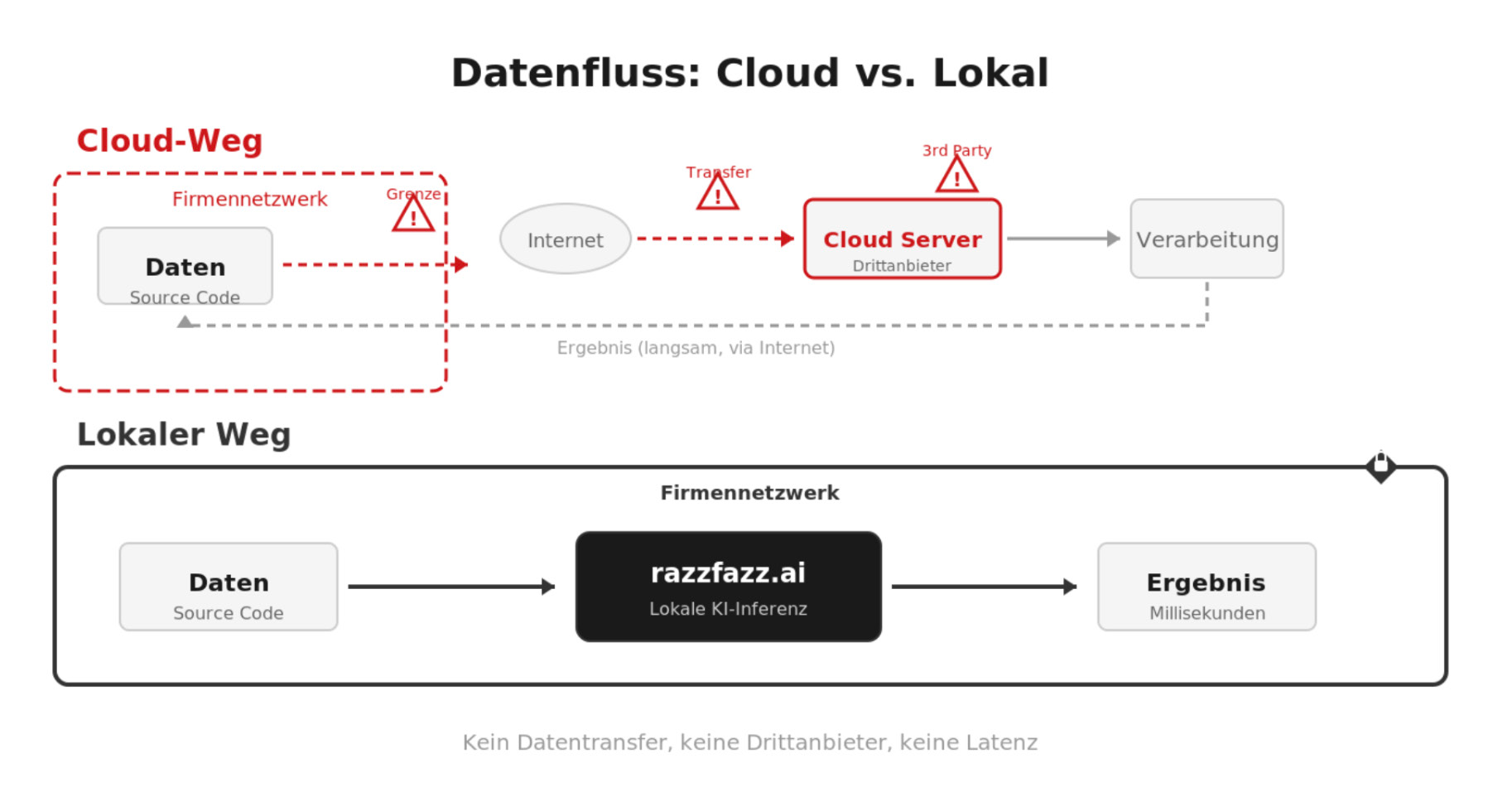
Scenario 1: code review with cloud AI. A developer copies a class from the internal ERP system into a cloud-based AI tool to carry out a code review. In that moment the business logic — pricing algorithms, discount tiers, customer classifications — leaves the company. Even if the provider does not store the data: during processing it sits in the RAM of a server that does not belong to you. A security incident at the provider, a government request (CLOUD Act, FISA) or a compromised employee — and your most valuable asset is exposed.
Scenario 2: test-data generation with personal data. A test team needs realistic test data for an insurance application. The simplest method: anonymise production data and load it into the cloud AI to generate variants. The problem: anonymisation is never perfect. Re-identification risks always exist. And uploading to a cloud AI is a data transfer within the meaning of the GDPR — with all the consequences that entails.
Scenario 3: strategic analysis. Management wants to use an AI to model competitive analyses, M&A scenarios or market-entry strategies. The fact that this information ends up in the cloud of a US tech corporation is not just a data-protection problem. It is a competitive risk.
In each of these cases there is one common solution: the intelligence has to come to the data — not the other way round.
4. The regulatory pressure: the AI Act and GDPR as accelerators
Anyone who believes that data sovereignty is a voluntary extra underestimates the regulatory pressure that has built up.
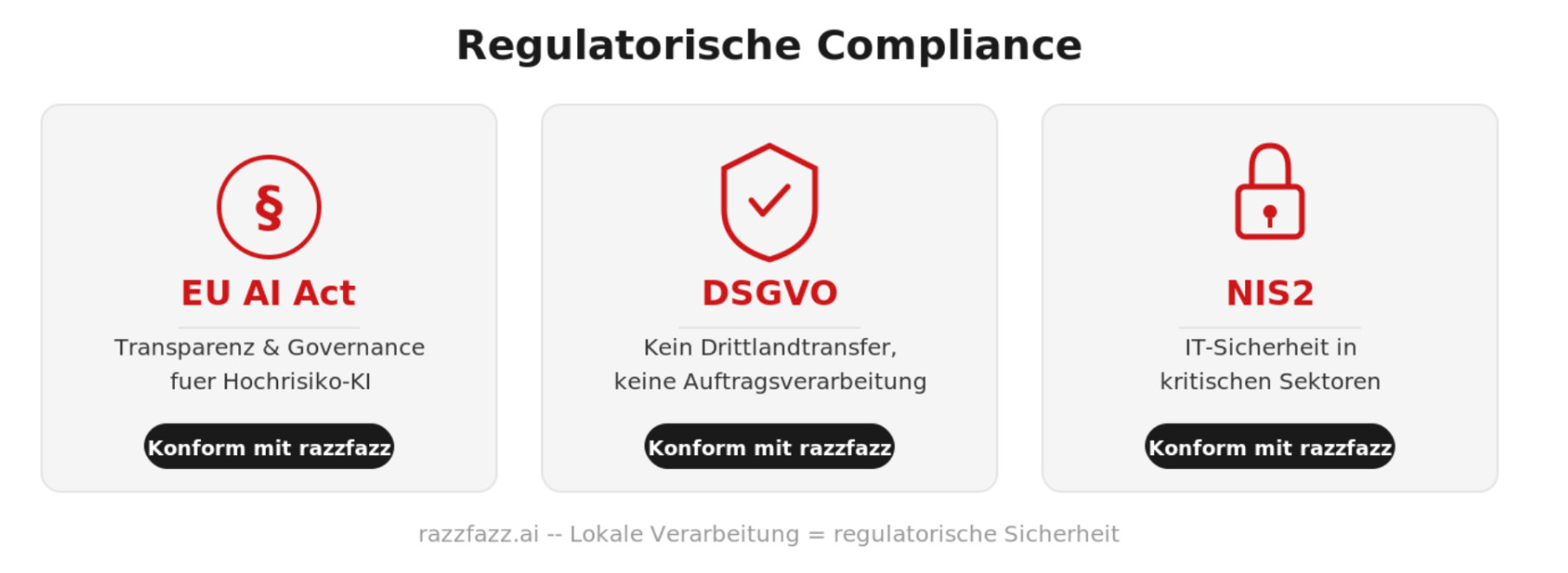
The EU AI Act, in force since August 2024, classifies AI applications into risk classes. For high-risk applications — and these include many enterprise applications in HR, lending and critical infrastructure — strict transparency, documentation and governance requirements apply. Anyone using a cloud service whose model they cannot inspect, audit or control will struggle to meet these requirements.
The GDPR remains the foundation of European data protection. Article 28 (processing on behalf of a controller) and Articles 44 ff. (third-country transfers) set high hurdles for the use of cloud AI services, especially when these run on US infrastructure. The Data Privacy Framework (DPF) does provide a legal framework, but its durability is — after the experience with Safe Harbor and Privacy Shield — fragile.
NIS2 tightens the requirements for IT security in critical sectors. The use of external AI services for security-relevant tasks must be considered and documented in risk management.
The message is clear: regulation rewards control. And control means: local.
5. The technological answer: why local AI works today
Just two years ago, “local AI” was a synonym for “slow and dumb.” The models that ran on consumer hardware were, at best, suitable for gimmicks. Those days are over.
Three technological developments have fundamentally changed the situation:
Unified memory architecture: modern hardware — on which the rzfz.ai Box is also based — eliminates the classic bottleneck between CPU and GPU. CPU and GPU share a common memory pool of up to 128 GB. That means: no copy overhead, no VRAM bottleneck, no performance drops with large models. We can run quantised versions of models with 70 billion parameters or more locally — in normal office environments, without a server room, at a power consumption of 30 to 300 watts.
Highly efficient open-source models: the open-weights movement has produced models that can compete with proprietary cloud services. Magistral (Mistral AI) is a dedicated reasoning model that solves complex logical tasks through chain-of-thought analysis. Devstral (also Mistral AI) is specialised in agentic software-engineering tasks. Qwen3-Coder-Next (Alibaba) delivers outstanding results in code generation and analysis. All of these models are open source, can be run locally and are auditable.
Quantisation without loss of quality: techniques such as 4-bit and 8-bit quantisation (GGUF format) massively reduce memory requirements with negligible loss of quality. What two years ago required a 50,000-euro GPU cluster today runs on a compact box on your desk.
6. The rzfz.ai Box: data sovereignty as an architectural principle
With rzfz.ai, we at SEQIS have not developed our own “AI.” We have done something more important: we have created a platform that enables companies to run any open-source AI model sovereignly and securely.
The Box is a hardened Linux system (Ubuntu 26.04 LTS) with an integrated software suite:
- llama.cpp as a highly efficient inference engine for quantised models
- Workflow automation for orchestrating AI agents (comparable to n8n, but local and containerised)
- PostgreSQL + pgVector as a local vector database for RAG systems (retrieval-augmented generation)
- Open WebUI as a user-friendly interface with multi-user support
- Docker containers for isolated, reproducible deployments
The crucial point: every component runs locally. There is no “phone-home” mechanism, no telemetry, no cloud fallback. The Box can — if desired — be operated in a fully air-gapped network. No internet, no exposure, maximum control. With the rzfz.ai Subscription you receive instructions for offline updates.
What the Box delivers in practice. The use cases are varied and cross-industry:
- For development teams: automated code reviews, unit-test generation, legacy-code modernisation, API test design — all without a single line of code leaving the company network.
- For test teams: GDPR-compliant synthetic test-data generation, intelligent test-case derivation from requirements, self-healing test suites that adapt to code changes.
- For management: strategic analyses, document evaluation, knowledge management — based on a local RAG system that accesses your internal concepts, wikis and test plans.
- For compliance officers: full transparency about the model used (open source, auditable), no third-country transfers, no processing on behalf of a controller, complete control over input and output.
7. The cost comparison: why “local” is cheaper than you think
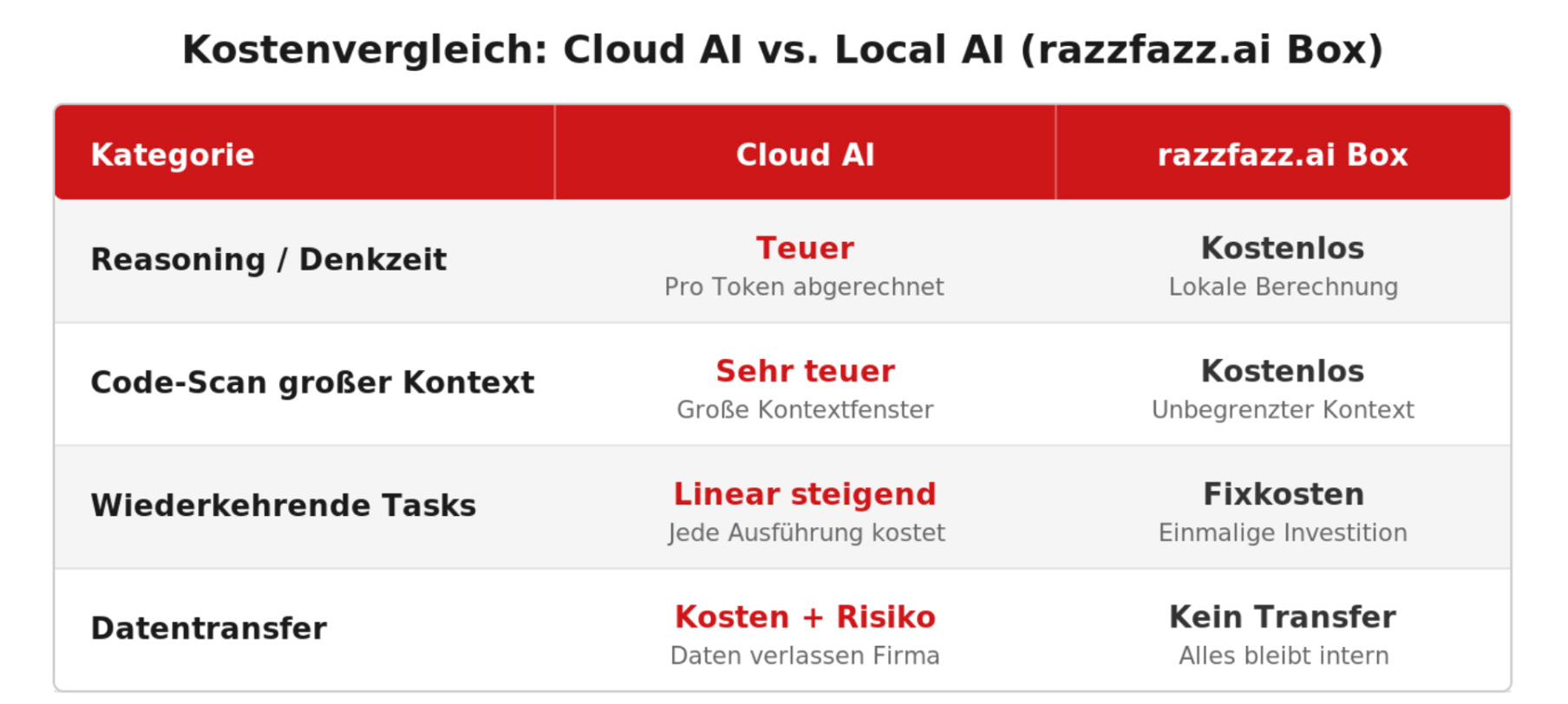
A widespread prejudice: “The cloud is cheaper after all — I only pay for what I use.” That holds true for simple requests. For reasoning models and agentic workflows that generate thousands of tokens per request, the maths quickly turns around.
For a development team using it intensively, the Box typically pays for itself within a few months. And it has a psychological effect that should not be underestimated: when the AI is “free” (because it is already paid for), developers use it more often, experiment more and integrate it more deeply into their workflows.
8. Conclusion: my data, my rules, my property
The AI revolution cannot be stopped. But how we shape it is in our hands. The question is not whether we use AI, but where and under what conditions.
Data sovereignty is neither a luxury nor a brake. It is an architectural decision that keeps companies capable of acting in the long term. It is the basis for innovation and compliance not having to be a contradiction.
The technology is mature. Unified memory hardware, open-source models and intelligent orchestration make local AI practical, powerful and economical today. The rzfz.ai Box is the proof.
Don’t wait for the cloud to become safe. Take back control. Because in the end it is not about technology. It is about a basic principle as old as property itself:
My data. My rules. My property.
Sources and further information:
- EU AI Act — Regulation (EU) 2024/1689, eur-lex.europa.eu/eli/reg/2024/1689
- GDPR — Regulation (EU) 2016/679, dsgvo-gesetz.de
- NIS2 Directive — Directive (EU) 2022/2555
- rzfz.ai — Local. Open source. Independent. Secure., rzfz.ai
- SEQIS — Your local AI consultancy, seqis.com
- llama.cpp — High-performance LLM inference, github.com/ggml-org/llama.cpp
- Mistral AI — Magistral & Devstral, mistral.ai
- Qwen3-Coder — Alibaba Cloud, huggingface.co/Qwen
Published in QualityNews H1/2026