The End of Human Designers? The Impact of AI on Graphic Design Jobs
Between more creative freedom and the fear of job losses
What not so long ago was still considered unimaginable by many is already reality today: artificial intelligence is now so advanced that it can actually take over the creative work of a human. At the push of a button, entire brand identities including logos can be generated. But is technological progress really already capable of surpassing the human creativity that has so far been regarded as irreplaceable? How limited are artificial intelligences when they imitate it?
It is a hotly debated topic whether AI can replicate the emotional depth of a creative process in such a way that no perceptible difference is noticeable to humans. The AI can imitate certain aspects of creativity, but when it comes to incorporating genuine emotional and personal connections into the design process, one simply cannot ignore the reference to one’s own human experiences. It remains the human being who feels their emotions and can express them in the form of art. Artificial intelligence does nothing other than analyse already existing artistic works in order to reflect certain characteristics and trends in the newly generated work by means of probability models.
More creative freedom through automation?
Tools based on artificial intelligence have nevertheless already begun to take over traditional design tasks. The following design tasks are handled without difficulty:
- Logos and brand identities
- Automated selection of colour schemes and typography
- Design templates for print media, websites and social media
- Automated placement of texts and images in design layouts
- Optimisation of images for the printing process
One might claim that hardly any work is left for human designers, right? The effects of this development are a little more complex. When automated processes can take routine work off designers’ hands, designers have more time and space for creative decisions. More unusual ideas that were previously associated with too much effort would thus be more easily realisable. But this also leads to the market value for repetitive design tasks falling accordingly, which could steer the market towards a major loss of jobs. Some voices even fear that AI could replace human designers in the long term.
Here are the advantages and disadvantages summarised:
Advantages:
- Efficiency
- Cost savings
- Scalability (various media and formats)
- Expansion of creative potential
Disadvantages:
- Lack of originality
- Not emotionally involved
- Loss of jobs
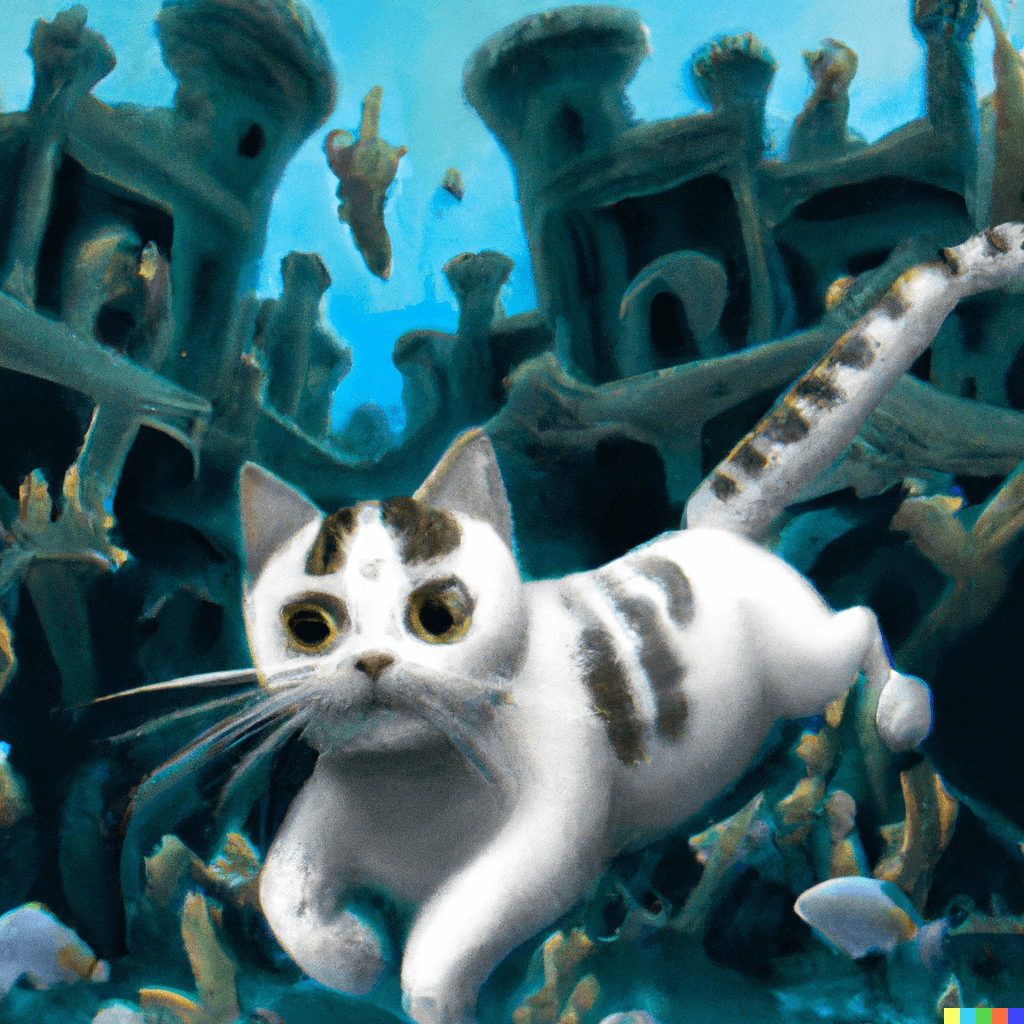
DALL-E is an AI model developed by OpenAI. The name “DALL-E” is composed of the names of the artist Salvador Dalí and the robot WALL-E. I tested the AI with this text: “A cat exploring an underwater castle”. Within seconds an image was generated that has probably not yet been drawn in this form until now. Web designs can also be generated with this tool. The results look modern and professional, but in my eyes they are anything but original.
Where do we draw the line between automation and intellectual property?
When generating graphic design elements with AI tools, the result is always based on the works with which the tool used was trained. According to § 1 para. 1 of the Austrian Copyright Act (UrhG), works are defined as “idiosyncratic intellectual creations in the fields of literature, music, the visual arts and cinematography”. However, under the current legal situation, only the result of a human activity is defined as an intellectual creation. An AI tool is therefore not regarded as an author. What additionally makes the legal situation considerably more complicated are the copyright-protected works with which the AIs were trained. In order not to create obstacles to technological progress, the EU adopted special rules for the training of AIs with text and data mining through the Copyright Directive (Directive (EU) 2019/790). This directive was implemented in Austria with the Copyright Amendment 2021. Thus the use of copyright-protected works to train an AI remains permitted, as long as the rights holders do not explicitly object by machine-readable means (§ 42h para. 6 UrhG).
Conclusion
Artificial intelligence brings both opportunities and threats. It was not long ago that panic reigned in the media industry because, with the invention of the first image editing programs, some traditional areas of work became superfluous. Despite the initial panic, the industry adapted as new fields of work emerged. It therefore remains exciting to see how the current transformation through artificial intelligences will develop this industry further.
Current AI graphic design tools
- Midjourney
- Nvidia Canvas
- Adobe Sensei
- Let’s Enhance.io
Originally published at SEQIS Blog