Artificial Intelligence: From Hype to Real Value
How to anchor AI meaningfully in the enterprise

Do you know “bullshit bingo”? We used to sit in meetings waiting to tick off terms like “disruption” or “VUCA.” Today, “AI” or “artificial intelligence” would be right at the top of almost every card. But beyond the buzzwords, the decisive question for us digitalizers, analysts and project managers is this: how do we avoid AI becoming the new “shelfware” – software we buy enthusiastically but which, in the end, gathers dust on the shelf because the real benefit is missing?
The technology is here. But between merely playing around and value-creating integration into critical business processes lies a long road. It is no longer about whether, but about how. We have to deploy AI professionally, safely and purposefully — much as we learned to do with test automation or RPA: focus on ROI and away from pure infatuation with technology.
Strategy before technology: defining the “why”
The most common mistake is “solutionism” – you have a solution (AI) and now frantically look for a problem. A successful implementation, however, always starts with the corporate strategy. Before the first line of code is written, we have to define what we want to achieve. Goals have to be measurable and pay directly into the vision. For us, that means finding metrics beyond “model accuracy.” We have to ask ourselves: does the deployment reduce lead times? Do we cut the error rate (“first time right”)? Or do we improve the customer effort score in support? Only if the return on investment (ROI) is right does the project have a future.
The framework: compliance and standards as a quality marker
Introducing AI is primarily change management. It is not enough to hire data scientists; we have to build broad AI competence across the company. Business departments have to understand what AI can do – and what it cannot. Here, analysts act as indispensable translators between business and tech, in order to establish “empowered key users” who see technology as a tool.
In this, the upcoming EU AI Act is not an obstacle but a quality marker. It forces us to classify risks early and to create transparency. Just as we learned with remote work that “security first” applies, with AI we have to ensure that we are not running a “black box.”
Flanking this, ISO/IEC 42001:2023 provides the necessary tool. I consider this standard an enormously strong “supportive”: as the first global standard for AI management systems (AIMS), it translates the regulatory requirements into tangible processes. For us quality engineers, ISO 42001 is the backbone for putting compliance into operational practice. It gives us structure, much as we know from quality-management standards, and helps us run AI not just in a legally compliant way but also in a trustworthy, risk-minimized one.
The course “The EU AI Act in Practice” offers a structured roadmap to not only understand the new regulatory requirements but to use them as a strategic opportunity for the company.
Across three hands-on modules, you gain:
- From the technical fundamentals
- Through the legal details
- To concrete implementation
the necessary toolkit, including checklists, to operate AI systems safely and in compliance with the law.
The training is available both as an open format (online/onsite) for individuals and as a tailored in-house solution for teams, and concludes with a qualified certificate as proof of competence.
The five pillars of a quality-assured AI rollout
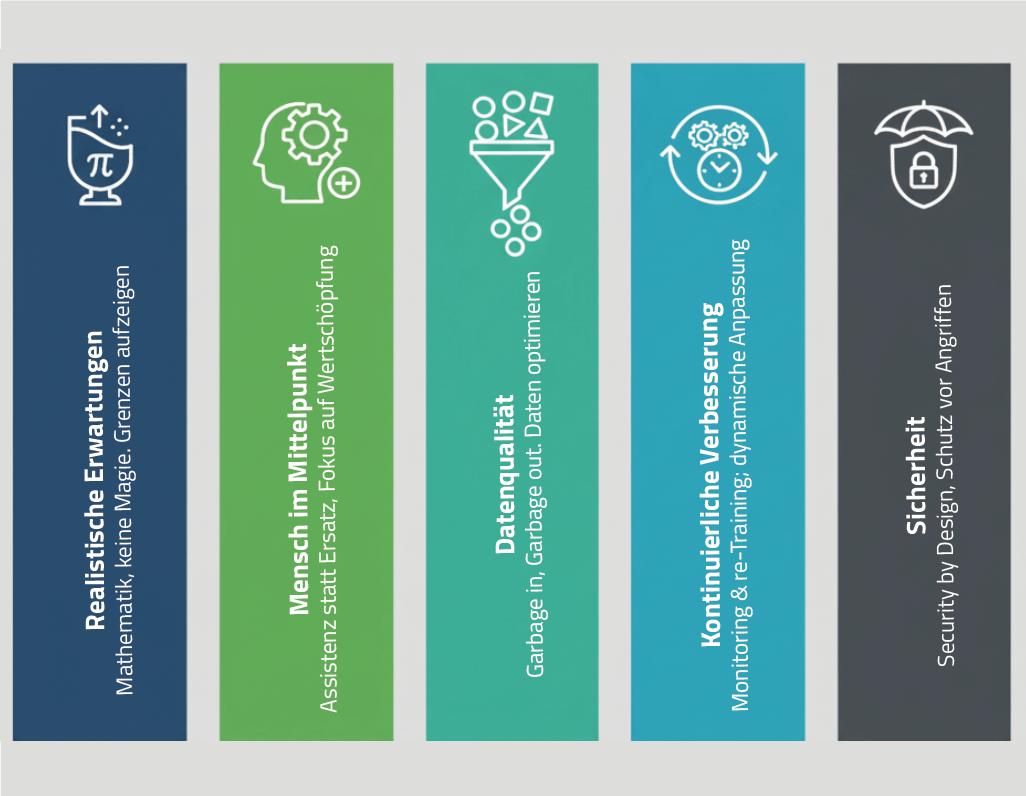
Anyone who takes software quality seriously knows: a system is only as good as its weakest link. With AI, five non-negotiable principles apply.
- First, we have to manage realistic expectations. AI is mathematics, not magic. As those responsible for IT, we have to temper management’s expectations: AI hallucinates, makes mistakes, and understands no context it has not learned.
- Second, the human belongs at the center (human-in-the-loop). The fear of being replaced is real. Our message has to be: AI should assist, not eliminate. We use automation to handle repetitive tasks so that time remains for value-creating work.
- Third, everything stands and falls with data quality. The old principle “garbage in, garbage out” applies here more than ever. A model trained on biased data delivers harmful results – here we have to optimize the groundwork and structure the data before we automate.
- Fourth, we need continuous improvement. Software is deterministic, AI is dynamic. A model that is good today can be useless tomorrow. We need constant monitoring, much as we monitor production systems.
- And fifth, security is not negotiable. AI models are new attack vectors. We have to build in security by design from the very start, in order to harden our systems against manipulation.
A look at practice: where the journey is heading
To whet the appetite for implementation, it is worth looking at the concrete opportunities on offer. In manufacturing, the efficiency becomes tangible: predictive maintenance analyzes sensor data to forecast failures before they happen, while image-recognition systems in quality control find defects faster and more accurately than the human eye.
In the financial sector and retail, it is about precision and personalization. Algorithms detect fraud attempts in real time or assess credit risks in a more differentiated way than rigid scorecards. At the same time, AI in marketing enables a hyper-personalization that recommends to the customer exactly what they need, instead of watering-can advertising – much as in the service area we create faster response times for the customer through automation.
Particularly exciting is the use in healthcare. Here AI acts as a “second pair of eyes” for doctors, analyzes X-ray images to support diagnosis, and massively accelerates the development of new medicines. And last but not least, in logistics AI optimizes supply chains and routes so efficiently that costs are reduced and delivery times improved.
Conclusion: start small, scale fast
Introducing AI is not a sprint but a marathon. Let’s begin with small, manageable pilot projects where the data situation is good and the benefit becomes visible quickly – where we find the “main streets of value creation.” Let’s learn from them, adjust our strategy, and then scale. The tools are ready – it is up to us to use them wisely and in a quality-assured way.
First published on the SEQIS Blog.
Originally published at SEQIS Blog